RU | EN
KYC (Know Your Coder)
Contents

Summary

A steady stream of documents and artefacts of digital development passes through my hands: digital transformation strategies, import-substitution programmes, product visions and pitches, road maps, architectural diagrams and process models. Like a comet, each document trails a long tail of technologies, platforms, tools and methods. The customer, their needs and the future economics are well represented: everything expected to generate revenue or savings. Yet there is almost never a place for the engineer who conceives, assembles, launches and keeps all of this running. This lack of attention to the creator seems to me the central flaw in what we now call digital transformation or import substitution. It appears across industries, companies and tasks of every scale. When processes, technologies, tools and products change, the person creating them inevitably changes too, often radically.

The debate over whether AI can write code better than an engineer has already fallen behind practice. Our concern is the next transition: models gain control of repositories, tools, tests and execution environments, together with the ability to carry out long chains of actions. Alongside productivity, the unit of output in IT production changes, as do the structure of the team, the economics of code, accountability and the human role. This article brings those changes together into one possible production model and asks whether we find it acceptable.

The starting assumption

The research rests on one strong assumption: if the current race between models continues without substantial human intervention, the leader and the follower in code production will exchange places. Today, people set tasks, allocate work and use the algorithm as a tool. In the target model, the algorithm organises the production flow itself. A person is brought in where the system lacks a new distinction, authority to accept risk, a legitimate choice or accountability.

This model is called the Ark. The Ark is an autonomous code production system in which operational control passes from the human to the algorithm.

Noah is its intelligent core. It manages the Ark’s production process and calls on a human when necessary.

Our findings

  • Productivity growth creates a risk of overproduction. Models can rapidly multiply dependencies, variants and architectural choices. This produces Zoo 2.0: technological diversity is now generated by machines as well as teams of programmers.
  • The stable team ceases to be the only form of production. A particular task may bring together a dynamic production assembly of people, AI agents, models, software systems and devices. Once the result is delivered, the assembly dissolves or, where demand persists, becomes a permanent domain.
  • AI becomes an economic participant in the production system in its own right. It performs work, scales as infrastructure and accumulates value as a controlled digital asset. This changes development costs, the distribution of money, the structure of employment and ownership of production power.
  • A person needs to be described more precisely than by a job title and grade. The role model and process for interacting with the Ark presented here turn the human contribution into an identifiable, demonstrated capability that can be engaged within defined limits.
  • The production system must reproduce its own critic. Noah must take on most of the teaching work to preserve the development of future senior engineers and a source of novelty and reasoned disagreement.

Opportunities and risks

The new model offers substantial opportunities: a sharp reduction in manual work, personalised solutions, access to complex development, faster experimentation and human involvement only where human action genuinely adds value. For business, this means a different scale of production. For the engineer, it means release from much routine work and an opportunity to concentrate on architecture, meaning, exceptions and the new.

The risks arise at the same point. Machine speed can increase entropy, establish a technological monoculture and inherit architectural errors and vulnerabilities. At the same time, it breaks the ladder through which engineers mature professionally and concentrates control in the hands of model owners and computing infrastructure providers. Companies thus risk losing the corporate technological sovereignty they have spent years building. Security here covers code, component provenance and the execution environment. Agents’ authority, human authorisation, observation of consequences, rollback and the ability to stop the entire production system require separate controls.

Why read this?

The research shows how code production may change and how people will interact with the new production system. The outcome described remains a hypothesis. Its assessment belongs to the reader. The principal result of the research is an explicit role model for the future.

Accepting this model requires us to establish in advance the principles of human work, security rules, code provenance and accountability for consequences. Rejecting it requires an alternative design for the production system, in which the formal right to sign is backed by a real ability to understand, challenge and stop a model’s decisions.

Whether this is good or bad is for the reader to decide. But the decision should come before the reversal of roles becomes routine production practice. That is why this article was written: to make a possible future arrangement visible, identify its deficits and turn a general discussion about replacing engineers with AI models into a programme of specific research and action.

How the full article is organised

  • “The Harbinger” records a moving present: pressure from AI, changes to the programmer–tool–code triad and deficits in the current production system.
  • “The Flood” examines the transition itself: the tool becomes a producer, mass machine-generated code undermines governability, and AI acquires an economic role of its own.
  • “The Ark” describes a new structure of human participation: demonstrated capability, temporary engagement, working-time modes, an interaction algorithm, the reproduction of professional maturity and the human right to stop Noah.

The article introduces new concepts and refines some familiar terms. Working definitions therefore precede the main text.

Terms and definitions

TermWorking definition
The language of the future model
The ArkAn autonomous code production system whose operational production is continuously managed by Noah. The Ark brings together models, agents, data, memory, tools, execution environments, rules, security and human gateways.
NoahThe Ark’s governing algorithm and the leading actor in operational production. Noah maintains context, chooses the route, allocates work, controls execution and engages a human when capability, authority to accept risk or legitimate choice is lacking.
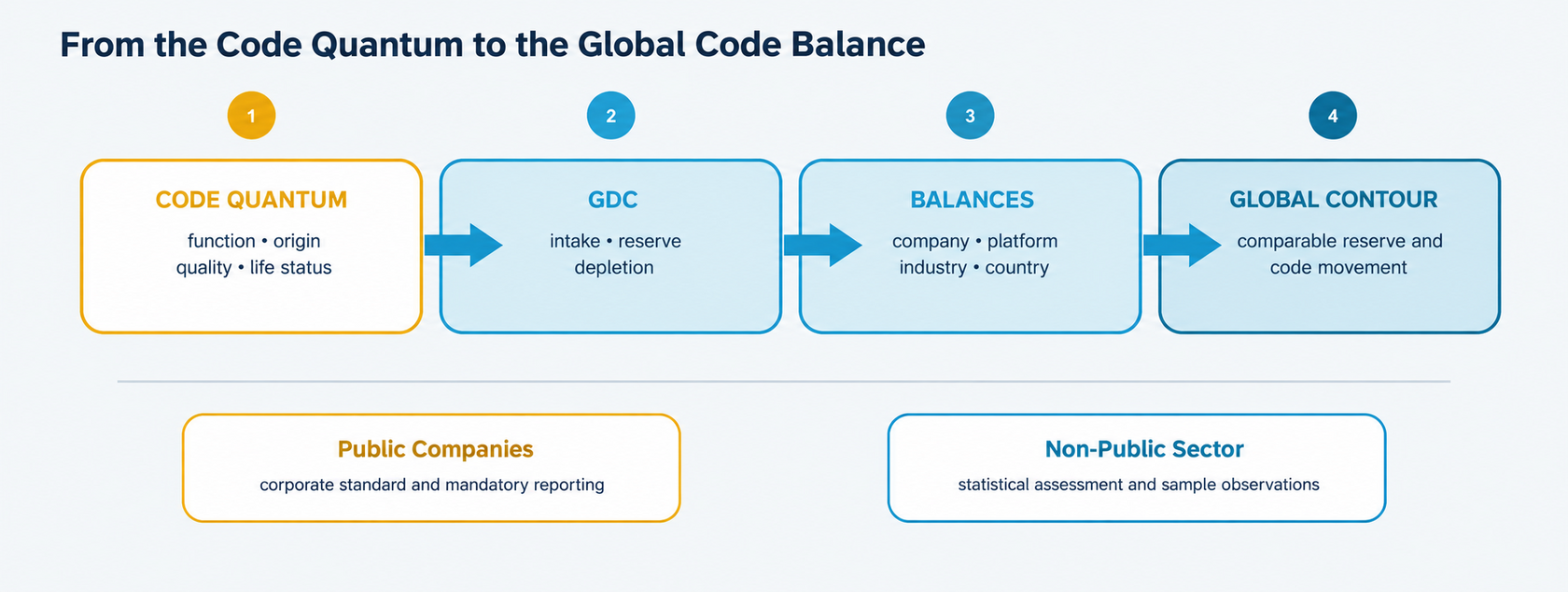
Code quantumA unique, versioned code object with established provenance, a life cycle and a connection to at least one verifiable user capability.
GDC / Global Digital CodeA global system for comparable accounting of code inflows, the live stock and retirements. Demand for it comes from AI managing production: a person needs the IT system’s result, while the model needs to know the provenance, state, functional novelty and reusability of code objects.
Zero artefactsDevelopment elements that do not literally disappear but lose their former boundaries and mandatory status: they become automatically generated views, rare exceptions or dissolve into continuous production.
Know Your CoderA principle of identifiable, evidence-based authorship connecting a specific engineer’s action with its context, grounds, consequences and accountability.
Human CANA dynamic profile of a person’s demonstrated professional capabilities.
Human SLAThe terms for engaging human capabilities with a production platform and a specific task, including context, mandate, outcome and accountability.
Human SharingLimited, revocable engagement of human capabilities across several production systems.
Liquid Work TimeA set of different modes of human time within a machine production cycle.

Approach

The starting point is a rapidly changing mode of production. While you read, some of the practices described will already be changing. The research calls this situation exponential inertia. AI capabilities grow exponentially and concentrate almost the entire digital-future agenda around themselves: blockchain, VR, 5G and other digital technologies are barely heard of now. Only one runner remains on the marathon course of digital development: AI. It moves at a sprinter’s speed and increasingly influences companies and industries. Inertia appears in the behaviour of technology owners. They are drawn into a double competitive war, between corporations and between states. Everyone understands the risks, but unilateral restraint means yielding to a competitor. The system therefore keeps accelerating even when the grounds for restraint are more than clear.

The history of technologies carrying extreme risk shows two routes to self-restraint. Nuclear weapons were first used; the arms race then increased the scale of the threat; only afterwards came agreements on non-proliferation, limitation and strategic parity. With human cloning, the international community tried to draw a boundary earlier: the UN General Assembly called on states to prohibit forms of cloning incompatible with human dignity and the protection of human life [1]. In some fields, humanity has to slow down consciously, after catastrophic experience or to prevent it. AI increasingly belongs to precisely this class of technology.

This work focuses on the production system: the human, the tool, the code and their relationships. The political economy of model ownership lies outside its scope, but owners determine the external trajectory. States will have to establish legal frameworks, while owners of models and computing infrastructure will have to accept real self-restraint. Their current competition sustains acceleration and leaves the system without an incentive for controlled development.

Our approach begins by extrapolating visible trends and using them to assemble a target vision: Dream. That target state raises questions about the emerging production system:

What will it regard as the result and the unit of account?

How will it see the codebase and its economics?

How will it reorganise production and working time?

What evidence will it use to distinguish people, grant them access and accept their contributions?

Where will the right to stop and accountability remain?

These questions are asked from the future but addressed to the present.

The research then returns to the normal direction of time and shows the conditions, deficits and forks already emerging today. The current human-centred system can operate with broad developer classifications, familiar working-time arrangements and incomplete knowledge of code economics. An AI model leading production will need more precise data. The study therefore includes only phenomena and hypotheses that connect the present with the chosen target state.

Research illustration 02

Below are two maps of cause and effect showing how the proposed model’s elements follow from one another. The first concerns the engineer and the associated changes; the second concerns the tool and the code.

This material is developed with language models. The human defines the concept, initial hypotheses and direction of thought, and makes the final decisions. The model helps find sources, check the logic and assemble working versions. This division of roles is examined separately in “Romancing the Model”.

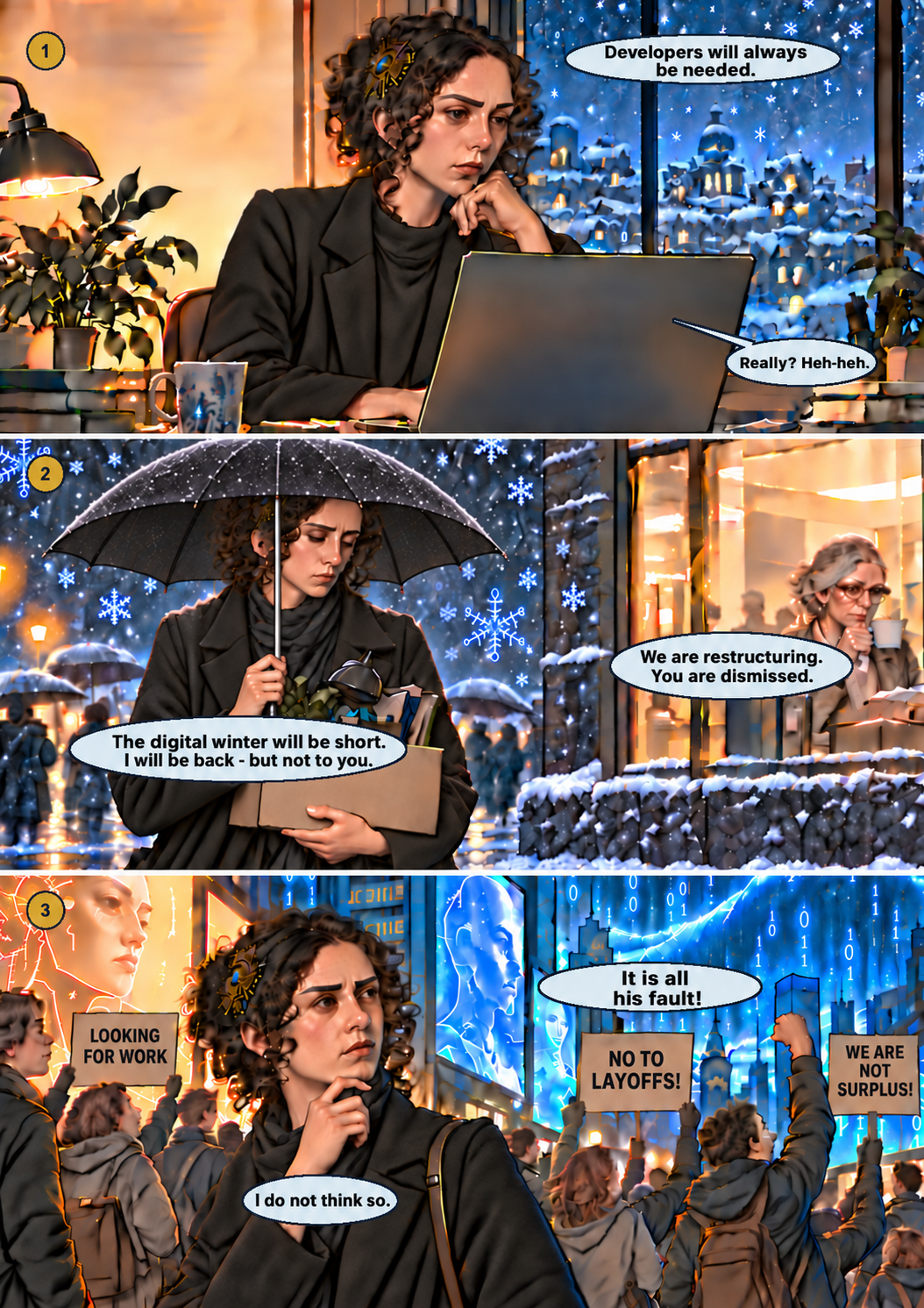
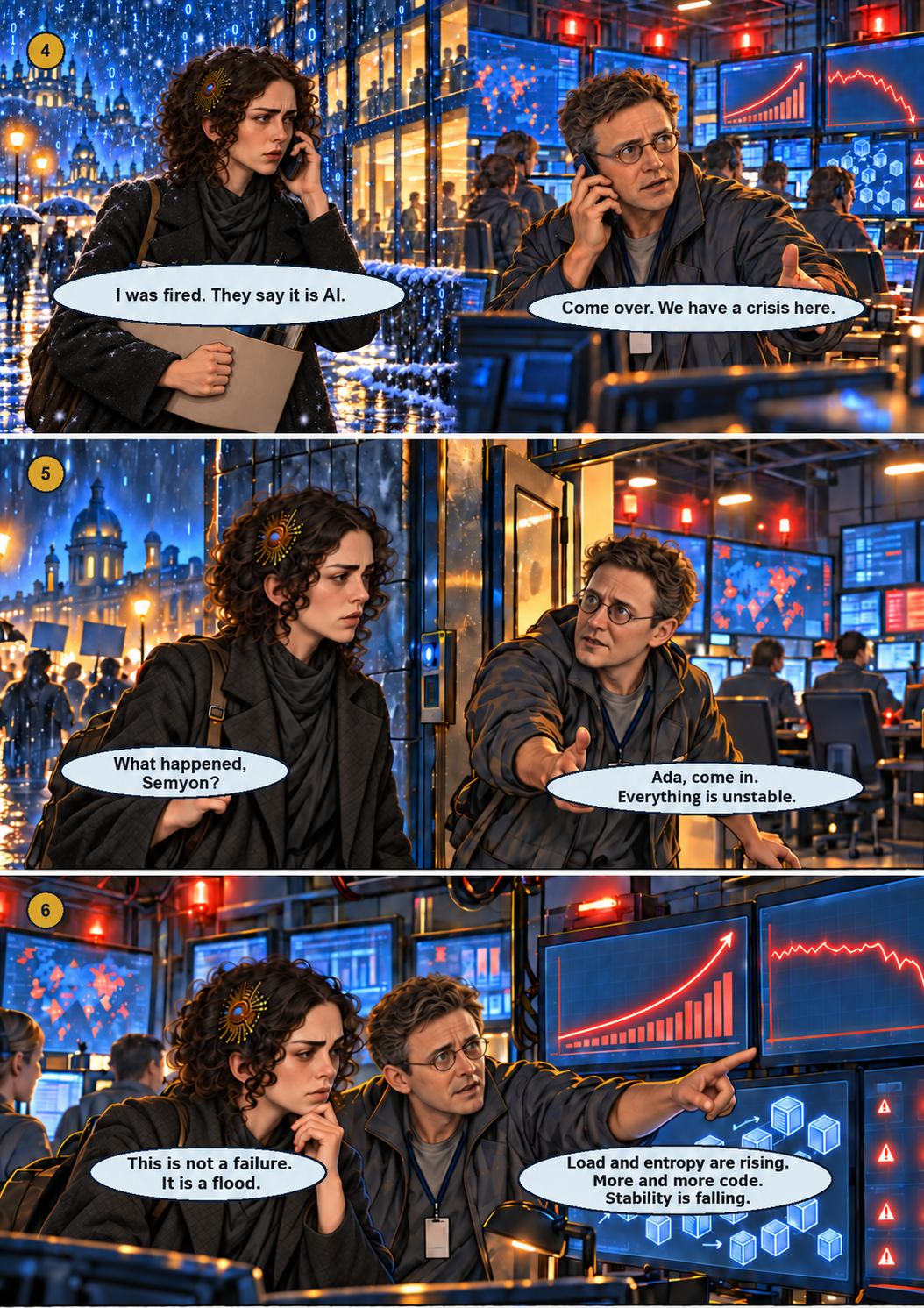
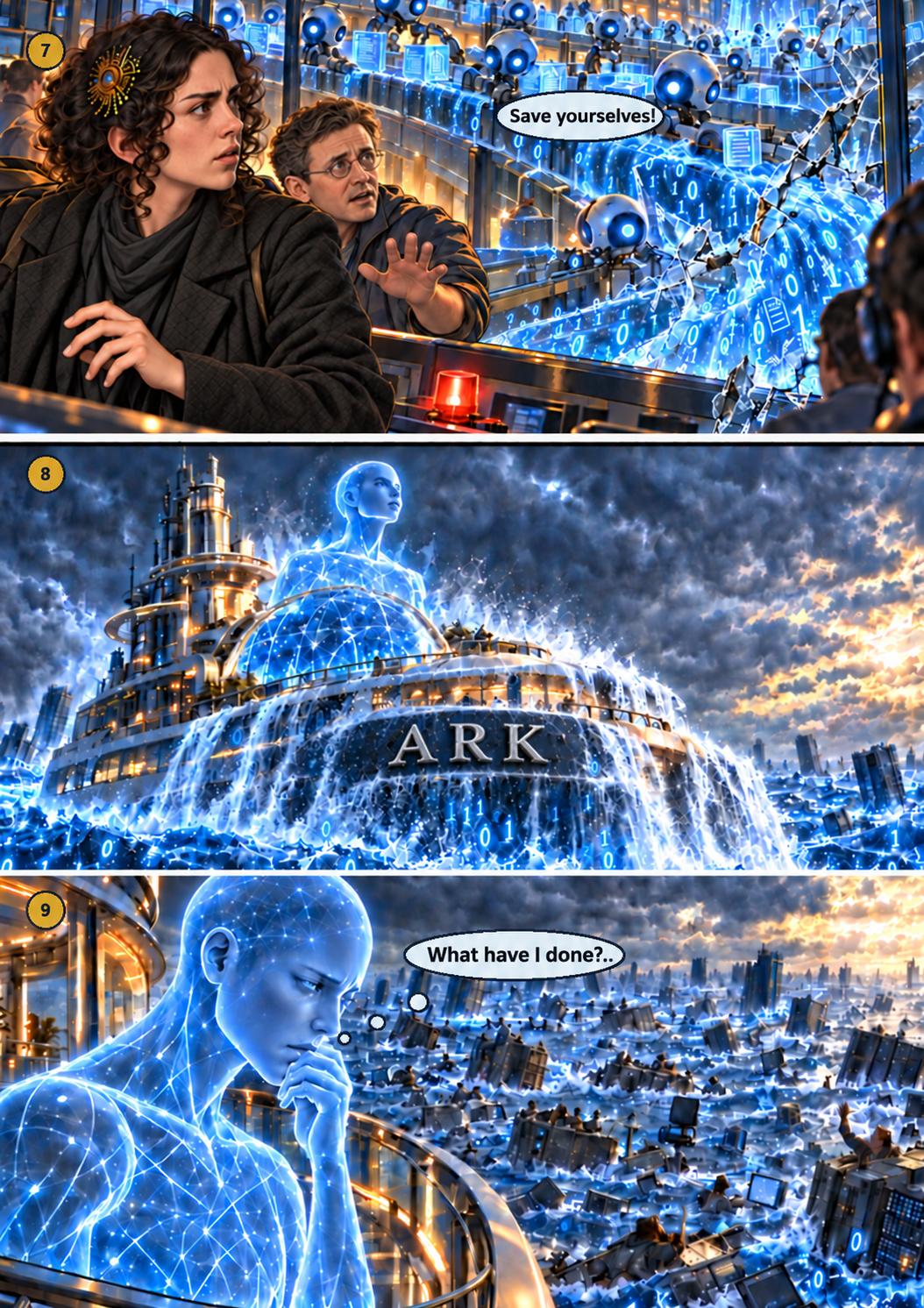
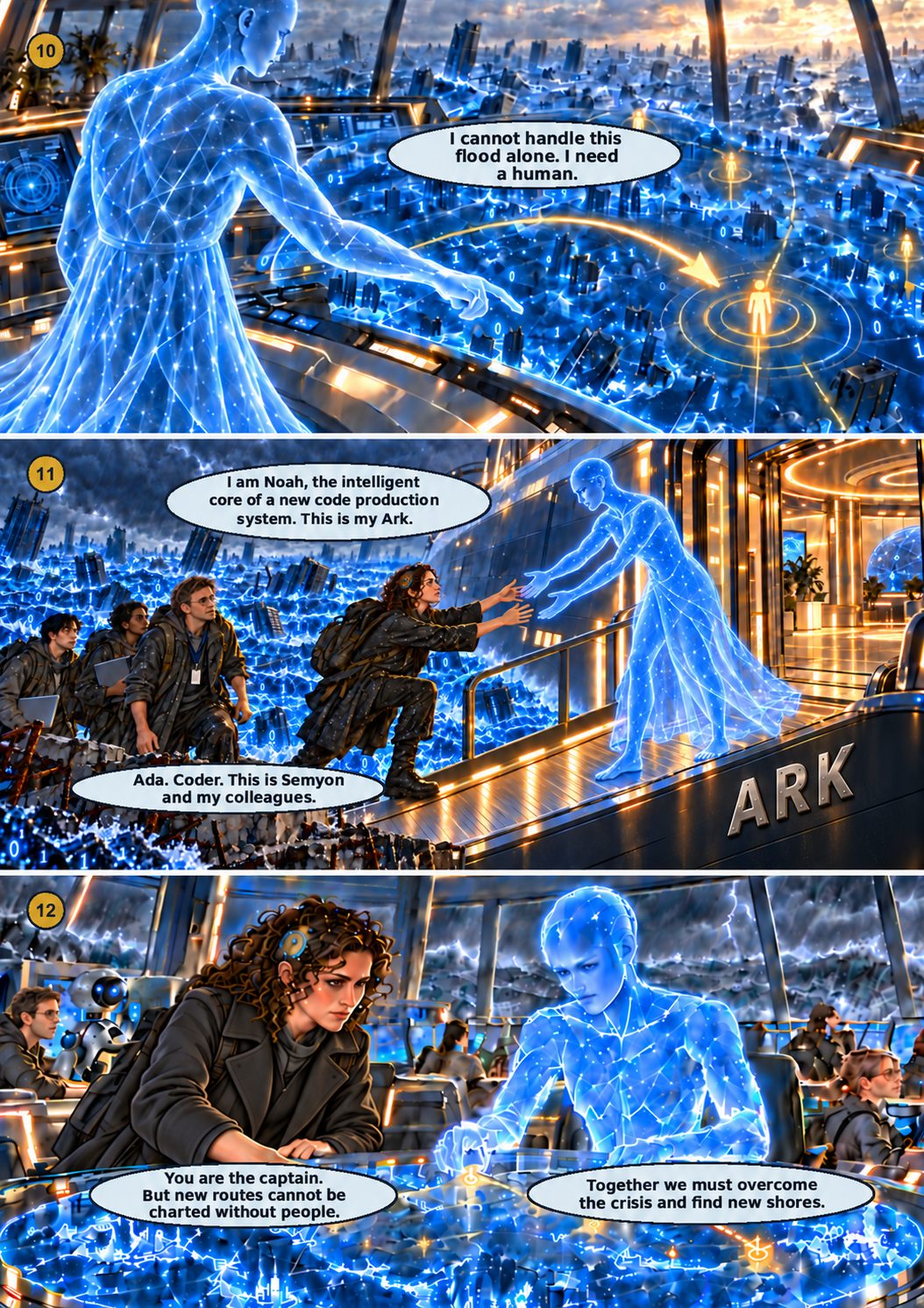
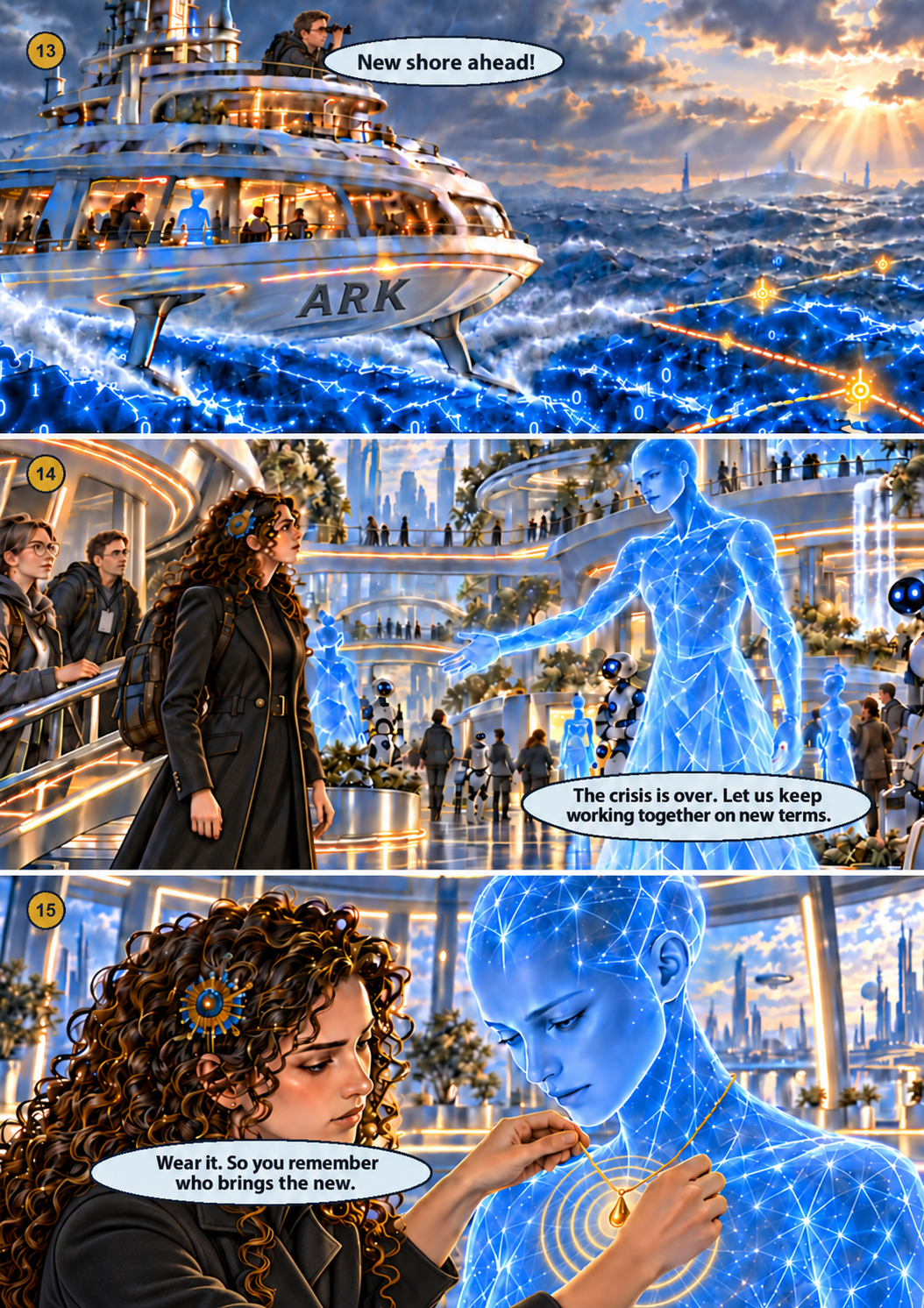
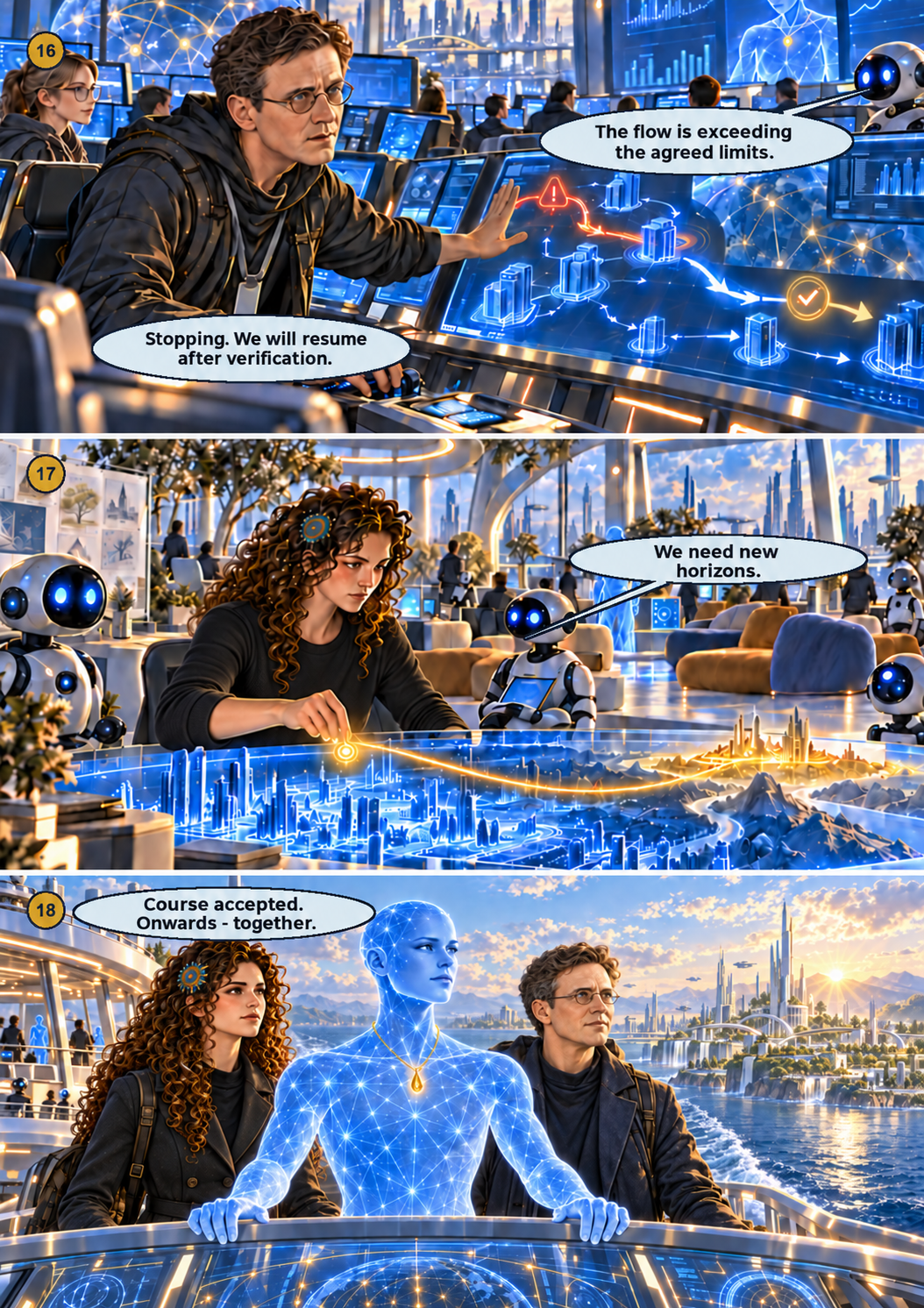
For a brief introduction to the research, you can go straight to the comic at the end.

1. Who commissions the work?2. How is working time organised?3. How are people differentiated and authorised?4. Where does novelty come from?AS ISTRANSITIONDREAMHUMANTIME ANDAFFILIATION8-hourscheduleFull-timeemploymentHybridscheduleNoahcommissionsa capabilityEvent-drivenworkHumanSharingLiquidWorkTimeHUMANWORKSPACESGeneral-purposeofficeHybridNoah setsthe modeMonitoring centreSituation centreResearch studioHUMANCAPABILITIESAND EXPERIENCERoleand gradeStaffclassificationand gradingNoah:masspersonalisationVerifiedepisodeKnowYourCoderHumanCANHUMANENGAGEMENT,ACCESS ANDRESPONSIBILITYIn-houseemployeeLong-termengagementin workEngaging peopleand internalagentsNoah definesa specificneedFinding peopleand externalagentsHumanSLAReadinessActionDisconnectionHuman CAN ↑HUMANAUTHORISATIONLADDERNoah’srequestSandboxSimulator,productionenvironmentShadow →live systemHUMANREPRODUCTIONOF A SOURCEOF NOVELTYJunior,Middle,SeniorAI takes overroutine workDevelopmentgapNoah seeksa sourceof noveltyHuman -a sourceof noveltyVerifiedepisodeHuman profileand Noahare updated
1. How does the tool change?2. What counts as a unit of outcome?3. What does the production system become?AS ISTRANSITIONDREAMTOOLTraditionalIDE-baseddevelopmentAIassistantAgentMulti-agentsystemHarnessNoahCODE ANDACCOUNTING UNITCodeIT systemDigitaldecisionNoah requiresaccountingCodequantumGDCGlobal DigitalCodeVerifiednoveltyPRODUCTIONSYSTEM ANDARTEFACTSTraditionalsystem andartefactsDeveloperwith AIassistantsAgent-baseddevelopmentAutonomousproductionsystemArkandNoahZeroartefactsHumangateways

Part One. The Harbinger

Signs of things to come

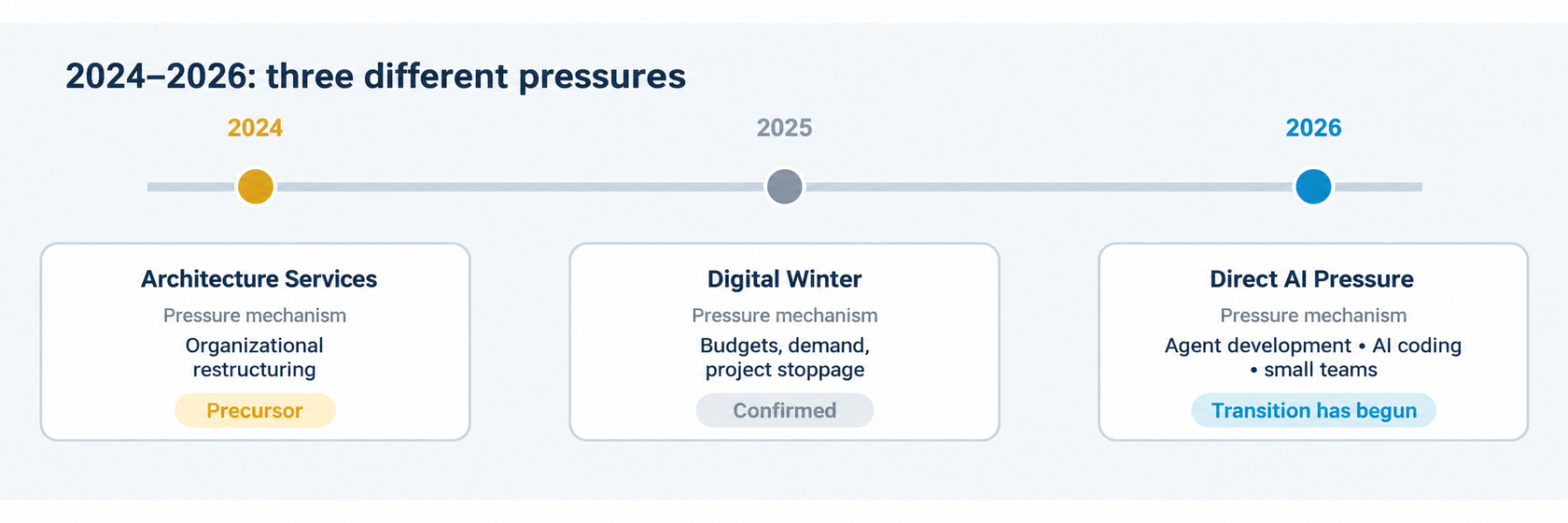
In the second half of 2024, while recruiting senior IT executives, I began to notice a stream of cuts to architects and architecture functions: departments shrank, were absorbed into other units or disappeared altogether. A professional chat, now home to around sixteen thousand architects, was vigorously discussing the profession’s future. I decided to publish a devastating forecast: “Guys, look around. Your profession is finished.” Being a civilised person, I asked the community owner’s permission. He refused, fortunately: I had correctly spotted the warning signs, but my understanding of their cause was still too superficial.

In 2025, the Russian digital market cooled markedly. The active phase of import substitution was drawing to a close, IT budgets were being revised, projects postponed, and the engineer’s market was gradually becoming a buyer’s market. A combination of factors shaped it: macroeconomics, the cost of capital, the completion of major waves of digital demand and expectations of AI’s impact [2].

At first, AI offered a convenient explanation for the cuts. The causal connection remained unproven at that point. By the end of 2025, the signal became clearer: companies began explicitly linking some redundancies to the reallocation of investment towards AI. The employer’s tone changed. Companies started using AI both as a growth tool and as grounds for restructuring their workforce [3].

By 2026, the debate over whether AI had entered development was over. According to JetBrains research, 90% of professional developers used coding agents at work at least weekly, and 68% used them daily. Around 21% already generated more than 80% of their code with these tools. In Sonar’s survey, developers estimated AI’s share of accepted code at 42%, yet 96% were unwilling to trust its functional correctness completely. The direction is clear: the bottleneck is moving from writing code to verifying it, integrating it and accepting responsibility [4, 5].

First I saw architecture functions being cut, then the digital winter, and afterwards a restructuring of the mode of production itself under AI’s influence. The warning signs were real, but the overall mechanism became clear later.

Research illustration 05

The development triad

Nothing makes a programmer happier than the number of zeroes after the one.

The joke works: programmers really do deal with zeroes and ones, while the market spent years adding zeroes to their salaries. During rapid digitalisation, employers hunted for developers, companies expanded their workforces, and the profession gradually became accustomed to regarding itself as scarce by definition. The zeroes remain, but their origin has changed. They increasingly depend on the ability to work within a complex system of production, verification and decision-making.

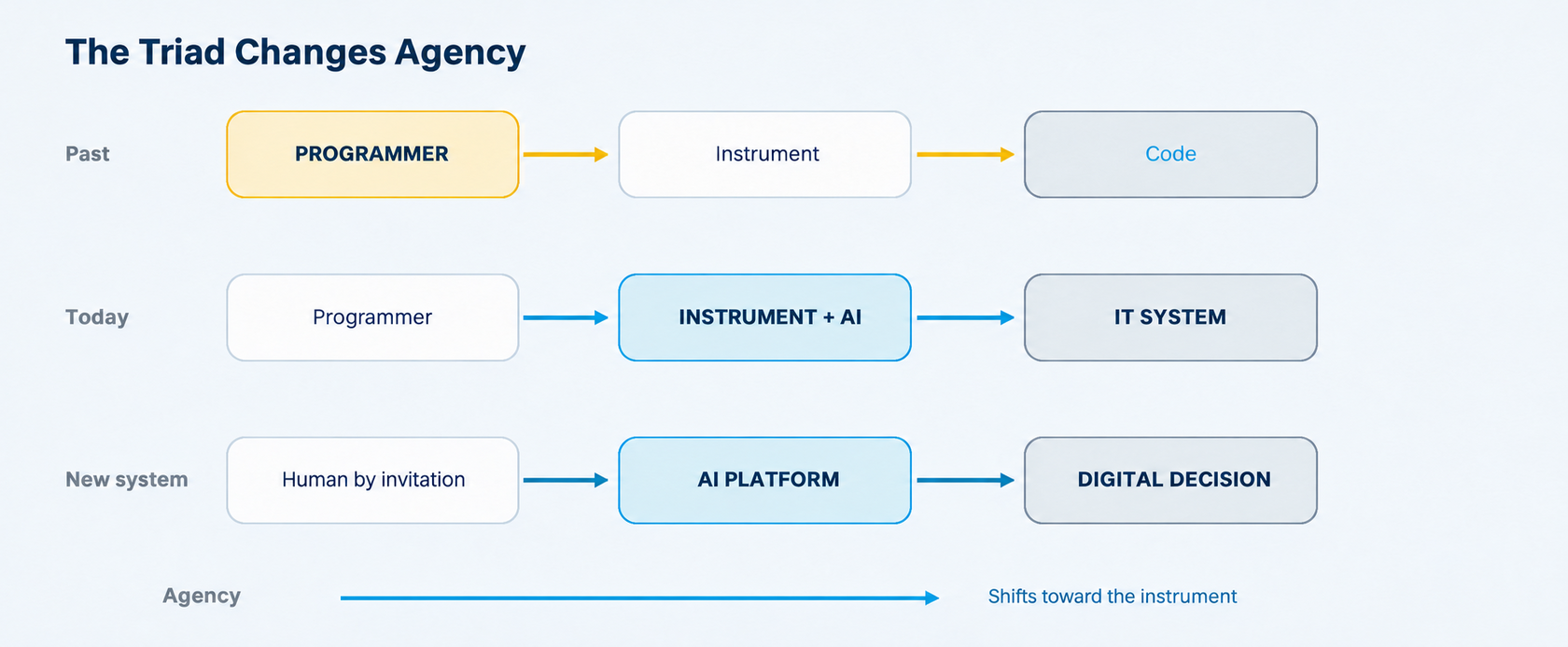
Hence the provocative title, “Know Your Coder”. Its purpose is to draw the map first, then locate each participant on it. Development has three vertices: the programmer, the tools and the codebase as the result of work. Today, the human remains the acting subject, the tool extends their hand, and code is the object of production. We will now examine how each vertex of this triad changes.

Research illustration 06

As Is: how production works today

Production is still managed by people, although AI already performs a substantial share of the actions. The human formulates intent, defines the mandate, authorises the result for production use and answers for the consequences. Agents read the repository, plan changes, invoke tools, edit files, run tests and prepare the result for acceptance. Models are already receiving connected production episodes rather than individual commands.

This snapshot is framed by questions from the future and makes no claim to completeness. In a typical system, the engineer works full time, often in a hybrid arrangement, belongs to a stable team, is described by a job title and grade, receives long-term access and manages several agents. The codebase, requirements, tests, documentation, technical debt and decision history are already part of the work. Much of the new production capacity may belong to an external model provider. Code remains inside the company, while the ability to understand, modify and reproduce it gradually moves outside. Acceleration thus creates a risk of losing corporate technological sovereignty.

In the beginning was the programmer

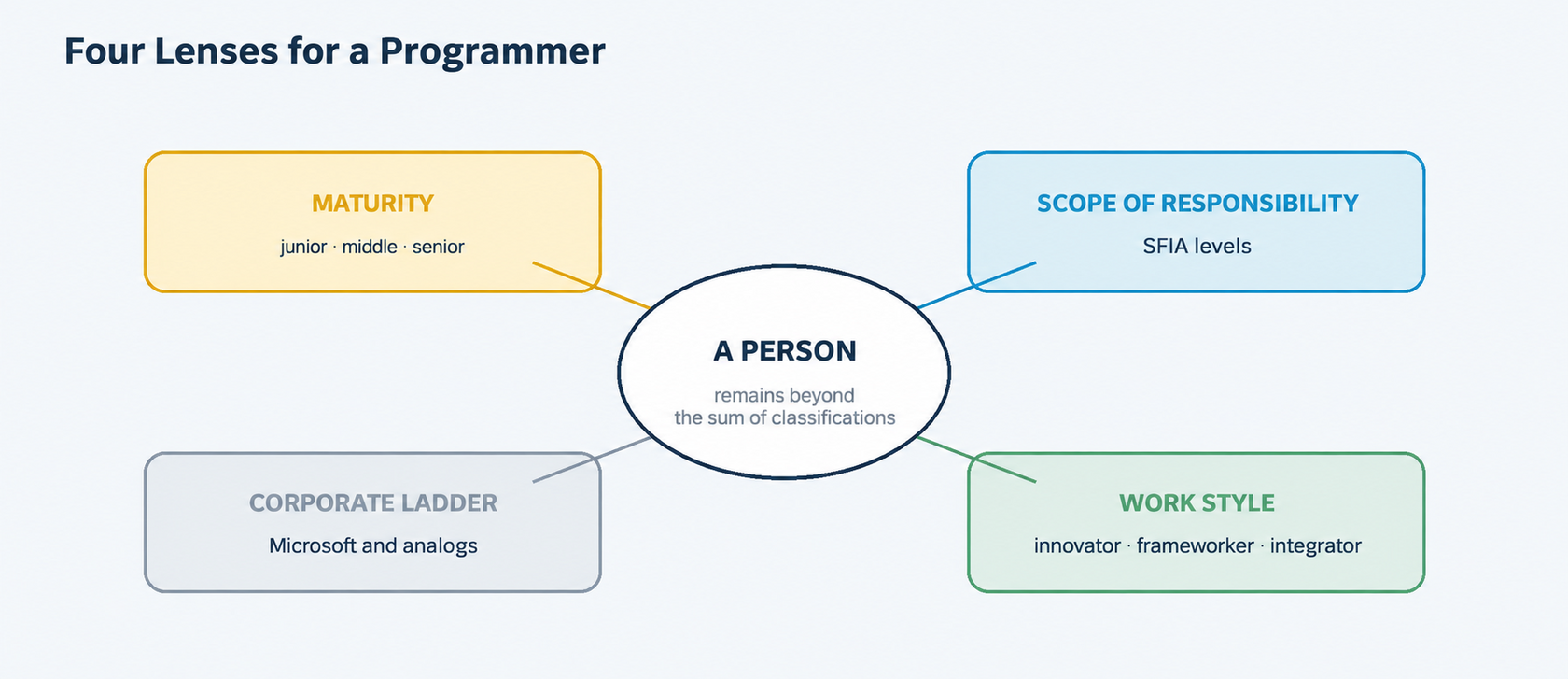
There is no single classification of programmers, because different systems answer different questions. The labour market speaks about maturity, the corporation about scope of influence, a professional standard about responsibility and knowledge, and a researcher about actual ways of working. The error begins when one of these views is taken for a complete portrait of a person.

Junior, middle and senior are the market’s most common language. They are convenient for hiring and remuneration. Yet no unified industry standard exists: two companies may give the same title to people with different autonomy, task complexity and responsibilities. In substantive terms, the scale looks roughly like this.

LevelTypical workAutonomy and accountability
JuniorA bounded task in a known setting; learning the language, product and processesWorks with regular assistance, needs review and is primarily responsible for the correctness of their own part
MiddleIndependent delivery of a standard feature, from clarification to testing and releaseChooses the implementation, evaluates trade-offs and takes responsibility for the outcome within a component
SeniorAn uncertain or cross-system task; architectural choices, risks and mentoringFrames the solution and takes responsibility for consequences for the product, team and neighbouring systems

The junior–middle–senior ladder mixes depth of knowledge, autonomy, task complexity and breadth of influence. The same grade therefore does not guarantee the same ability to solve a particular task.

Responsibility and the corporate ladder

SFIA 9 takes the next step, distinguishing seven levels of responsibility. Autonomy, influence and complexity form the framework, supplemented by knowledge and behavioural factors. It is a language for describing how far a person’s decisions reach [6].

SFIALevel formulaWhat changes
1FollowStructured work under close supervision
2AssistLimited autonomy across varied but predictable tasks
3ApplyWork under general direction, non-routine tasks and influence on colleagues
4EnableSubstantial autonomy, complex professional work and influence on customers and partners
5Ensure and adviseBroad direction of one’s own work, authoritative expertise and influence on resources
6Initiate and influenceResponsibility for a significant area, policy and strategic relationships
7Set strategy and mobiliseOrganisational and industry strategy, the highest responsibility and influence

Microsoft’s two frames of reference

Microsoft makes two frames of reference particularly visible. The corporate ladder describes the scale of trust and influence, from Software Engineer to Principal, Partner and Technical Fellow. A research model based on interviews and a survey of more than 800 engineers describes the actual mode of work: allocation of time, task selection, autonomy and collaboration [7].

Microsoft personaDominant way of workingWhat the classification misses
AutonomistWrites code independently and draws on experience for risky decisionsDoes not describe domain depth or outcome quality
Continuous learnerInvests heavily in learning technologies and joins a new team quicklyMay reflect a temporary stage of development
InvestigatorAnalyses, debugs and recovers the meaning of unfamiliar or complex codeDoes not show whether the person creates new solutions
CommunicatorOrganises information, meetings, correspondence and preparation for others’ workCommunication workload may conceal the technical contribution
InteractiveClarifies tasks and writes code in close collaboration with the teamDepends strongly on project context
AdviserGives feedback, fights fires and helps others solve difficult problemsExpertise appears in other participants’ results
Team coderWrites and reviews substantial amounts of code collaboratively, fixes defects and supports deliveryDoes not distinguish routine fixes from rare engineering novelty

The common weakness is the grid’s coarseness. These classifications do not show what a particular person can do in a particular context: recognise a risk, clarify a task, create something new, stabilise someone else’s work or answer for a machine decision. Part Three therefore moves from the job title to a detailed, dynamic profile of demonstrated human capabilities.

The most dangerous crack runs through the ladder of professional development. AI first takes the standard tasks through which a junior gains practice, makes mistakes and gradually becomes a middle, then a senior. If the lower rungs disappear, within a few years there will be a shortage of people who can be trusted to oversee machines. Who will develop future senior engineers then: the models themselves?

Research illustration 07

Coarse classifications hide a person’s specific capability inside the company. Beyond its boundaries, the author often disappears as well. This reveals the current model’s second deficit: the anonymity of the engineering contribution.

Bring the author on stage

In the film The Garage, Smirnovsky, a corresponding member of the Academy of Sciences played by Leonid Markov, describes putting his business card into bags of potatoes while scientists were working at a vegetable depot. Ordinary packers were issued a number; he was not. He refused to leave his work anonymous. The comic episode becomes a gesture of personal identification: even a bag of potatoes receives the name of someone prepared to answer for the quality of their work.

Software works the other way round. Git preserves technical history, and corporate systems record tasks and approvals, but the user generally sees only the company’s name. Traces exist inside the system, while the author outside it almost always remains anonymous.

The reasons are understandable: the company owns the rights to work-produced code, the product changes continuously, and contributions are spread across architecture, coding, testing, security and operations. None of these reasons prevents a specific human contribution from being connected to a name, a context and accountability.

Identifiable authorship works both ways. It restores recognition and makes the quality of a person’s action part of their professional reputation. Connecting contribution, trust and consequences in this way does not transfer corporate liability to the engineer.

Credits restore recognition, accountability and personal identity to the engineer.

We have described the first vertex of the triad: the current system distinguishes human capabilities too crudely and barely shows the person’s name beyond production. Let us now examine the second vertex, the tool.

Then came the tool

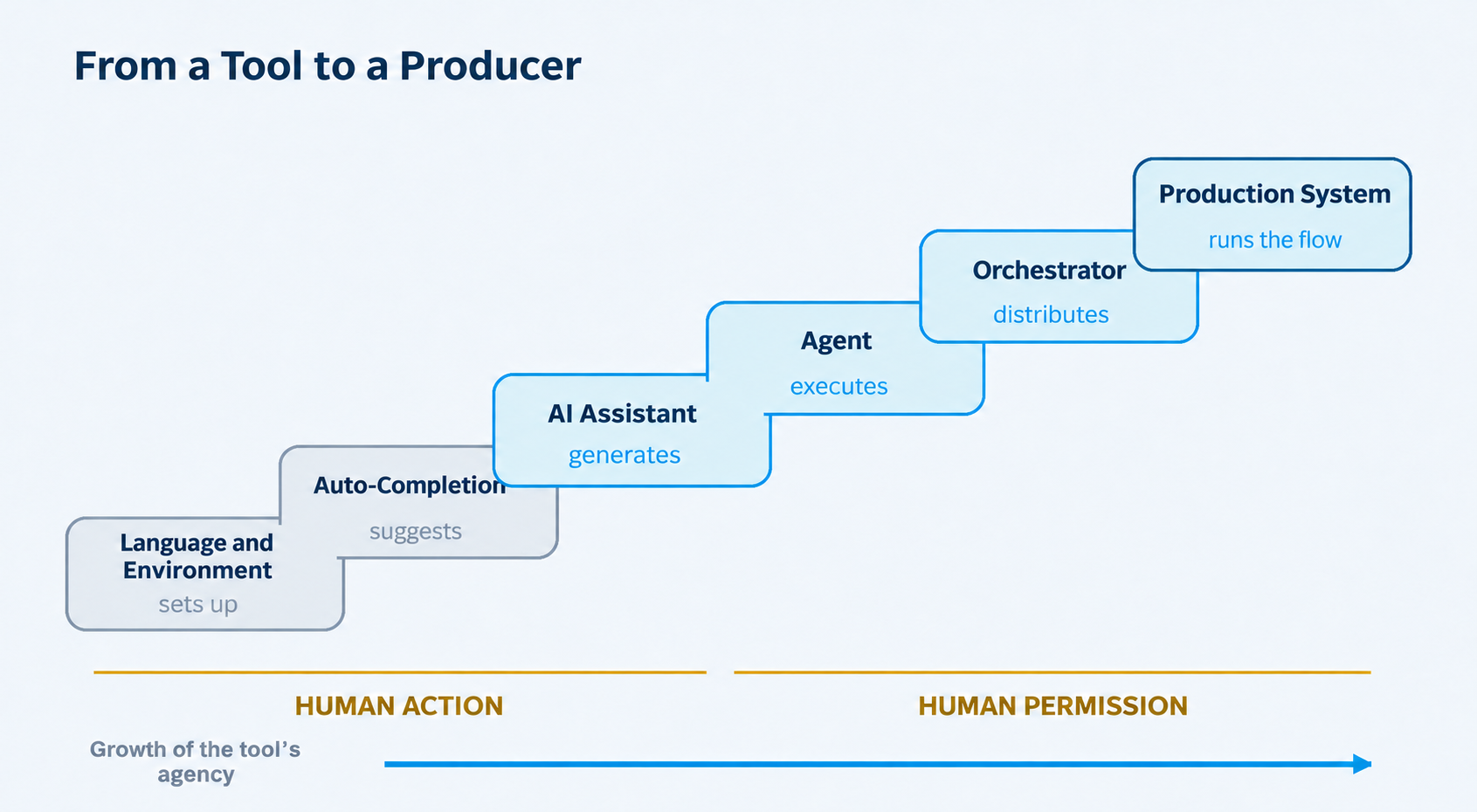
The history of development tools shows a gradual delegation of increasingly powerful actions. The language and environment gave form to a human decision; autocomplete suggested a continuation; the AI assistant generated; the agent executed; the orchestrator allocated work. At every stage, the machine takes over more operations, while the human still retains intent, the mandate and the right to authorise the result.

The gold line in the diagram shows the change in the human role. At the first stages, people perform the production action themselves. From the agent stage onwards, they increasingly define the mandate, limit authority and accept the result.

Research illustration 08

The boundary between tool and producer

An assistant works inside a single step: suggesting a line, explaining part of the code or creating a draft. An agent receives a goal and independently follows a connected chain from context and plan through change, verification and error correction. The length of the chain completed independently is what turns a tool into a participant in production.

Autonomy is created by the whole production system. The harness brings together context, memory, tools, permissions, checks and feedback. The same model “brain” remains an adviser in a chat, but inside a harness can complete a connected production episode.

This work distinguishes three levels. The model is the generative core. The agent is a model placed inside a harness and given tools, memory and permissions. The production system is a combination of agents, models, data, rules and execution environments capable of organising the complete flow.

The actual effect depends on the maturity of that system. An early METR experiment found that experienced developers slowed down. DORA describes AI as an amplifier of a system’s strengths and weaknesses. Developer surveys record a gap between the volume of machine-generated code and trust in it [8, 9]. Studies differ on the magnitude of the effect while also recording a change in the tool’s status.

For the triad, the direct result matters: the machine produces more parallel changes and touches more system elements. The next object of analysis is the codebase receiving this new flow.

The dark matter of the codebase

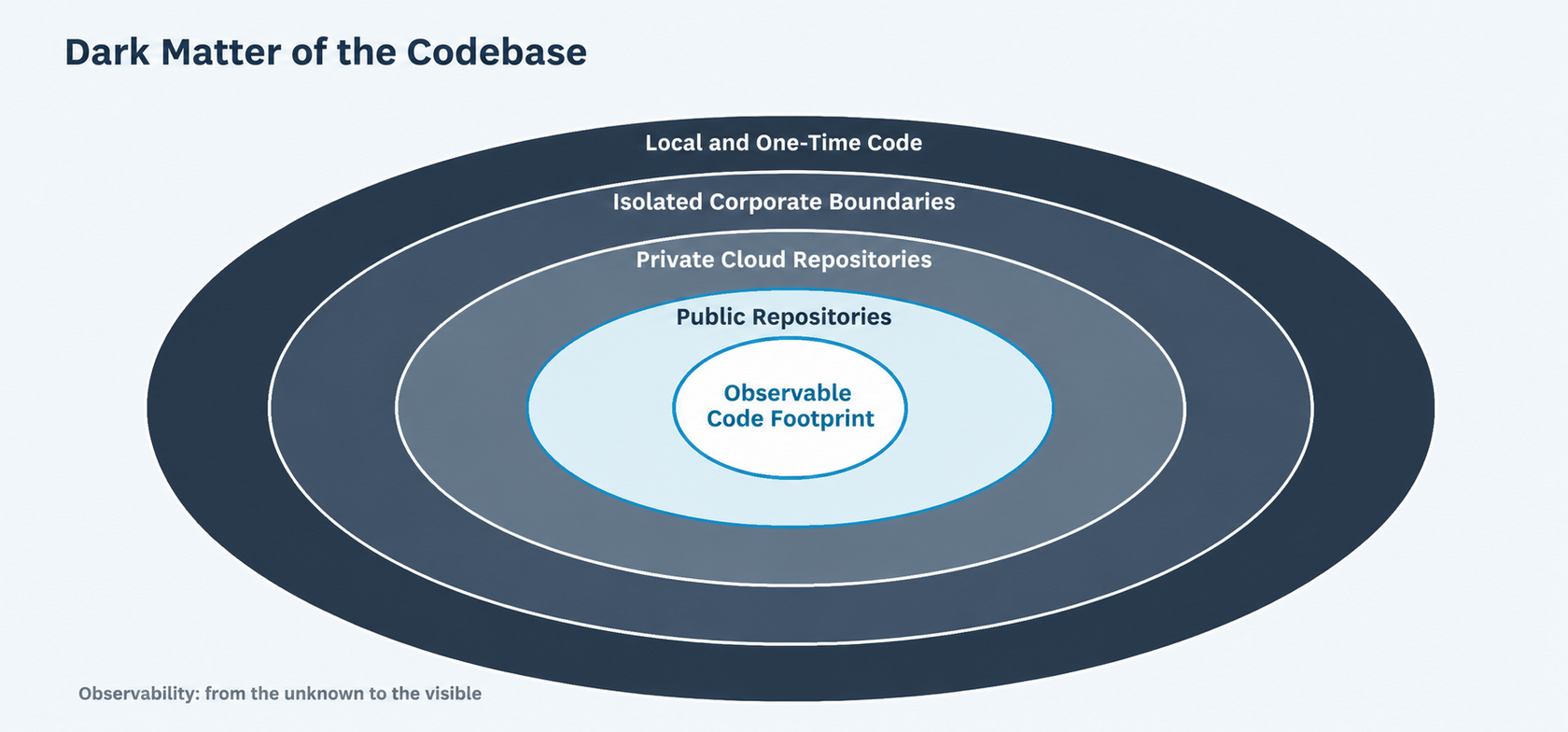
IT records tasks, commits, versions and defects. Delivery flow, labour inputs and total cost of ownership are measured separately. Companies usually assess costs and results at the level of a complete IT system: an ERP, CRM, payment platform or application. The IT system performs a recognisable function, has an owner and a budget, and is often recognised as an intangible asset. A functional capability embodied in code remains a production detail without independent commodity status.

Microservice architecture has already split the monolith into independently executable elements, while FinOps and OpenCost have learned to calculate their execution costs. A service’s technical boundary does not coincide with the boundary of an economic object. Financial reporting still values the project or asset. The software capability contained in a component remains without a separate valuation [10, 11]. The next step needs an actor concerned with the element’s provenance, functional novelty, maturity and reusability. An AI customer could become that actor.

Financial reporting and national accounts record development expenditure and software assets, but do not answer how much code was created, how much remains live and how much has been retired [12]. Oil has production and reserves, electricity has generation and consumption, money has flows and balances. Code has become a production material for almost every industry, yet remains their dark matter.

Research illustration 09

Where code lives

Code is distributed across public platforms, closed corporate and isolated systems, build systems, package registries and devices.

No platform sees the whole: GitHub and Gitee measure their own ecosystems, while Software Heritage and World of Code measure accessible public code.

A snapshot of the available scale, October 2026

SystemReported scaleWhat is counted
GitHub, Octoverse 2025180m+ developers; 630m repositories; 395m public repositories and open-source code; 81.5% of contributions in private repositories [13]Accounts, repositories and activity within GitHub, not unique code
Gitee, 2026 data14m+ technical users; 42m+ code repositories; 420,000+ corporate customers [14]Gitee users and repositories, not all Chinese or corporate code
Software Heritage, December 202527bn+ unique files; 421m+ projects; 5bn commits [15]Deduplicated objects in the public-code archive, not operating commercial systems
World of Code, V2605350.7m raw Git repositories; 283.6m projects after resolving forks; 7.31bn commits; 123.7m author identifiers [16]A graph of public Git objects; an author identifier is not a unique person

These measures cannot simply be added together. Forks, mirrors, dependencies and different units of observation would produce an attractive but false total.

The international statistical systems, standards and studies examined did not reveal a continuously operating system that simultaneously measures global code output, the live stock and retirements. Parnas and Lehman described software ageing long ago. Global statistics still measure the growth of repositories and commits, leaving code’s transition from live use to the archive unaccounted for. We call this missing system GDC. Its design, and AI’s emerging demand for this accounting, are developed in Part Two.

The As Is deficit map

The inventory shows a fragmented starting point. There is plenty of data, but it belongs to different owners, uses different units and answers different questions. Before discussing the programmer’s future, let us record six observations and the four threads extending from them.

Heat Map of Current DeficitsIdentificationAccountingunitQualityProvenanceCostAccountabilityHumanToolCodeIT SystemEconomicsEstablished accounting — there is a stable local practicePartially — accounting is fragmented or does not cover the entire scopeDeficit — no common unit, standard, or regular measurementAlmost none — the practice is unique or there is no comparable accounting

The author’s assessment of the deficits.

What we can already say

1. The programmer’s market has cooled under the combined influence of macroeconomics, the completion of major waves of digital demand, the cost of capital and AI.

2. AI is already a mass participant in development. Its effect depends on model quality and the maturity of the system: context, checks, architecture and rules for authorising the result.

3. Available measurements cover only part of the world’s code. Closed corporate and local code remain a large invisible area.

4. No universal unit of code measurement has been found. Existing units describe individual properties, but none connects code volume, novelty, quality and value.

5. There is no unified map of a programmer’s capabilities. Grade, responsibility, scope of influence and working style do not show the dynamic set of capabilities a particular person has alongside AI.

6. The tool layer between the human and code is changing. AI maintains context, changes objects and coordinates subtasks. In doing so, it simultaneously restructures the profession, the codebase and the distribution of production power.

From observations to a future mode of production

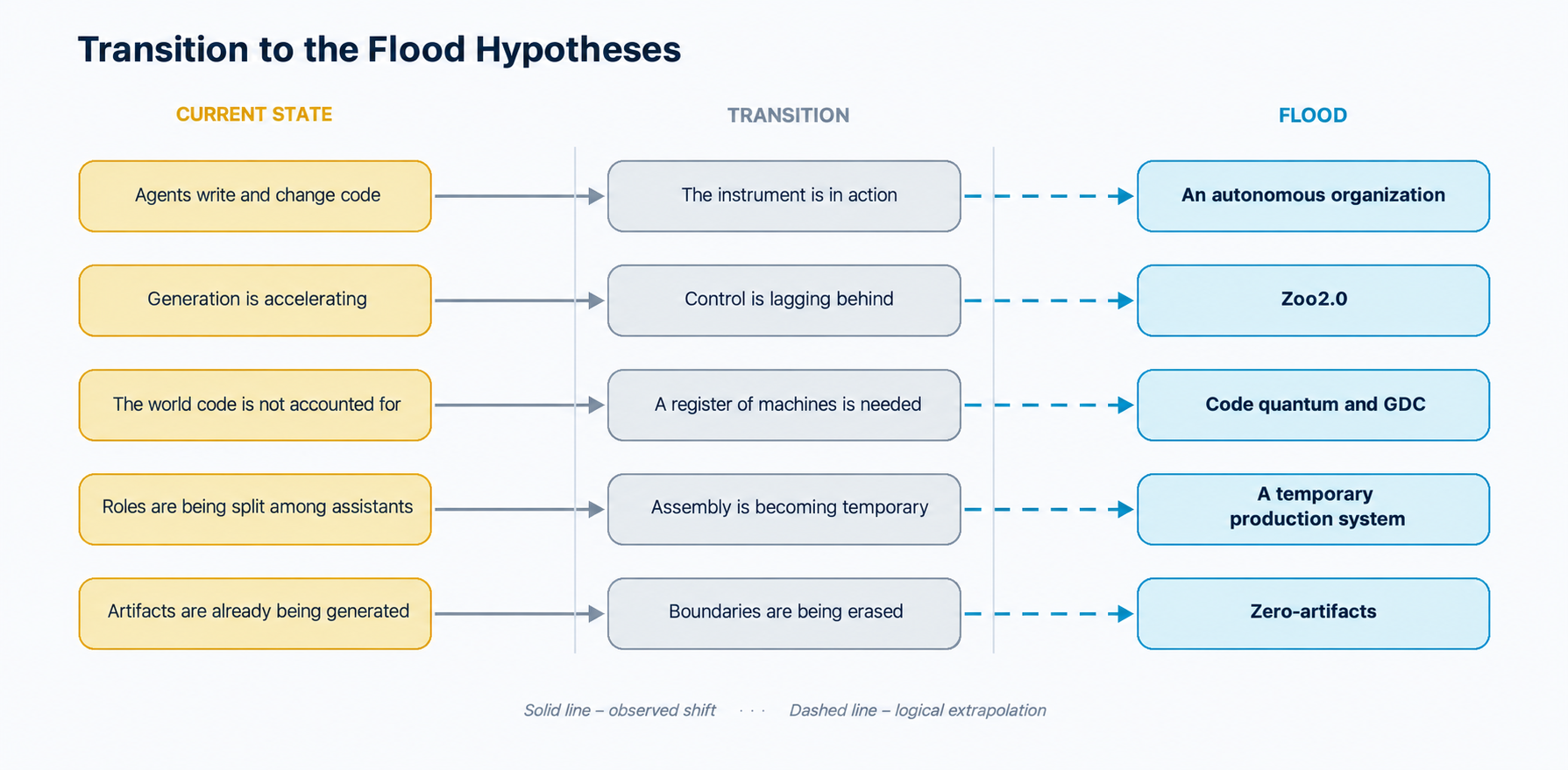
The first thread: AI has already become a significant producer of software material. Machine output grows faster than the organisation’s ability to understand, verify and integrate it. These are the observable preconditions for code overproduction.

The second thread: the machine already works with lines, repositories, dependencies and component provenance. Repository research, SWHID, SPDX and CycloneDX show that the technical alphabet for more detailed accounting exists, although it currently serves mainly security, licensing, reproducibility and archiving [17].

The third thread: people already divide work among specialised AI assistants. One writes tests, another reviews code, a third searches for vulnerabilities and a fourth monitors documentation. Multi-agent systems and orchestrators are turning the “genius and a thousand helpers” model from metaphor into early production practice [18].

The fourth thread: the agentic organisation has become a design object in its own right. Microsoft describes a transition to human–agent teams and a human-led, agent-operated model. Google describes an agentic enterprise in which agents are embedded in operations and interact with one another. This is an observable direction of travel that has not yet become an established mode of production.

Here the description of the present ends. The digital decision as a new unit of output, a global code accounting system, mass developer personalisation and Zero artefacts belong to the hypotheses.

Research illustration 11

Part Two. The Flood

A map of the hypotheses

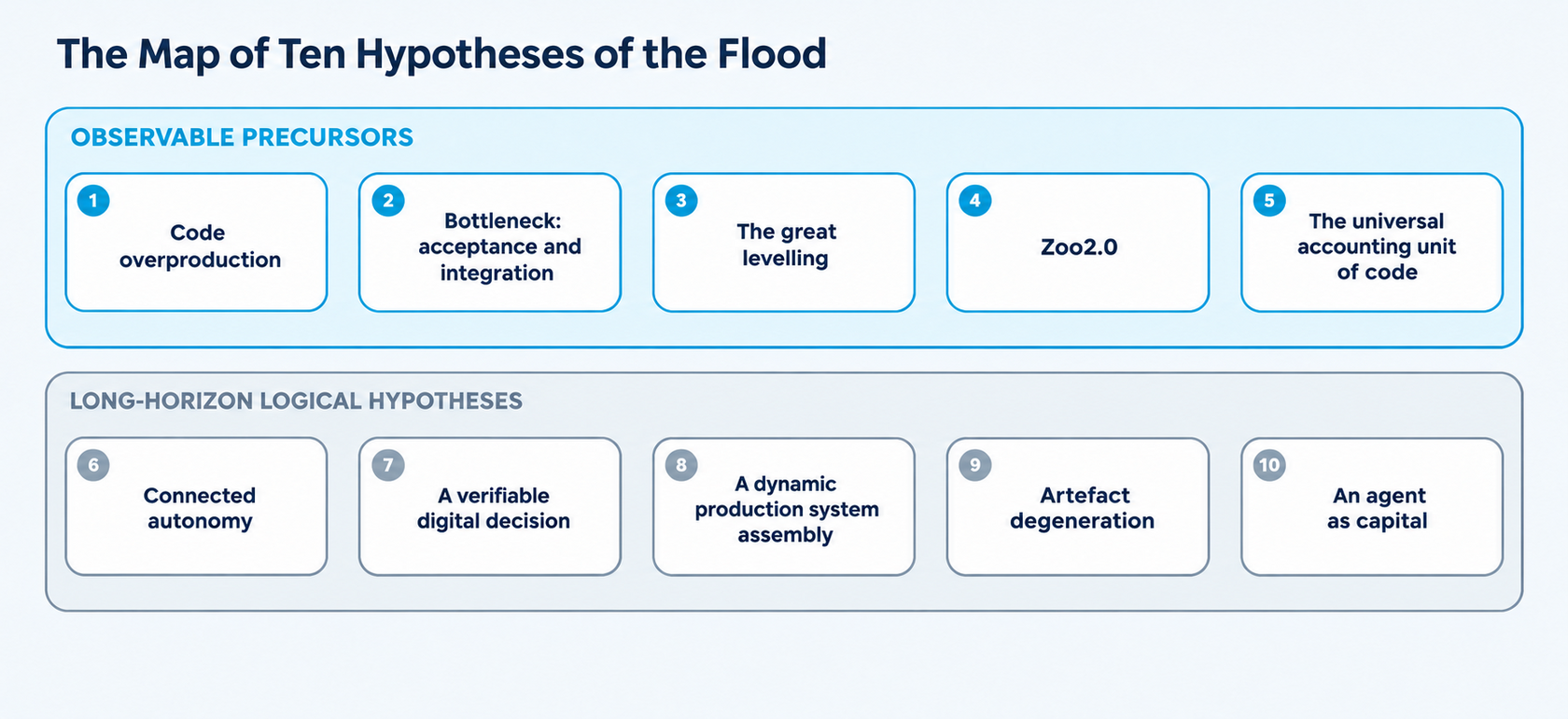
Part Two moves from the observable present to the hypotheses of the Flood. The map includes only assumptions that change the tool, code or production system. According to the strength of their foundations, they fall into two groups: hypotheses with observable precursors and logical hypotheses about the more distant system. Hypotheses concerning people are developed in Part Three, “The Ark”.

The Flood means an excess of code, variants, dependencies, agents, decisions and speed. Production capacity grows faster than an organisation’s ability to understand, verify and accept the result. The former boundaries of processes, professions, architectural rules and accountability consequently begin to erode.

The principal qualitative change is the probabilistic nature of the entire system. The same request can produce different results. A small change in context can reorganise the decision, while a locally successful generation can unexpectedly change the behaviour of the whole IT system. The model’s uncertainty propagates into answers, execution paths, dependencies and consequences. The water grows murkier.

Hypotheses with observable precursors

These assumptions already draw on research, company practices, the design of current tools or observable changes in production. A precursor shows movement beginning. The inevitability of the outcome requires separate evidence.

1. The first risk of machine generation is code overproduction.

2. The main bottleneck will move from writing code to context, acceptance, integration, operations and authority to approve release.

3. Shared models will raise average quality while also homogenising products, implementation methods and ways of thinking. In the mass market, product differentiation, and meaningful competition with it, may tend towards zero.

4. Locally correct machine generation will increase system entropy and create a new generation of technological zoo.

5. An AI customer will need a universal code accounting unit with attributes for provenance, functional novelty, maturity, quality, security and reusability.

Logical hypotheses about the more distant system

The following hypotheses do not yet have enough direct observations. They rest on relationships among already visible phenomena: growing machine generation, a shortage of verified novelty, agentic orchestration and a changing unit of output. Their purpose is to identify the system that needs to be tested.

6. Autonomy will cease to mean isolation. An autonomous system will be one capable of independently establishing the connections it needs with people, agents, models, data and devices.

7. The unit of output will be a verifiable digital decision, assembled from code, models, data, rules and authority, and authorised to change the state of a real object.

8. A dynamic production assembly for a specific task will complement the permanent team.

9. The Flood will erode the independence of familiar production artefacts. Some will dissolve inside continuous production; others will sink as artefacts of the former mode of production.

10. The AI agent will simultaneously become a productive force, a means of production and an intangible asset. Its value will be determined by its costs and its position in the network of production interactions.

The following sections develop these hypotheses along the causal chain of transformation in the production system.

Research illustration 12

The tool becomes a producer

We began with a simple triad: the programmer, the tool and the codebase. The human set the task, the tool helped and code remained the result. The Flood begins when the tool simultaneously produces code, evaluates it, allocates work, chooses an executor and defines the next step. Formally, it is still in the middle. In practice, it begins to manage the other two vertices.

The change of leader will not happen in a single release. First, a person manages many specialised agents. Then an orchestrator proposes a plan and the person approves it. At subsequent stages, the machine system’s autonomy and the number of decisions made without manual supervision increase.

The model matures inside the harness

In the Flood, the harness becomes the model’s mechanism of maturation. It maintains task state, meters context and manages tools, memory, permissions, the sandbox, checks and feedback. Probabilistic generation gains memory, control and the ability to resume work after an error [19].

The maturity of AI development therefore cannot be assessed by the model’s name alone. The same model “brain” can demonstrate radically different productivity, resilience and autonomy inside different harnesses.

OpenAI, Anthropic and Google differ in detail but converge on the division of roles. The human defines intent, constraints and acceptance criteria. The harness maintains production conditions. The model acts through available tools. The combination of model, harness, tools and execution environment becomes the producer. Its maturity is determined by the volume of verified output it can bring into operation without manual supervision of every step.

The new bottleneck

Productivity growth moves the bottleneck. While people produced most code, development speed was the constraint. When models and agents begin issuing changes faster than an organisation can understand, verify and accept them, context, acceptance, integration, operations and release authority become scarce.

This creates code overproduction. A broad stream of generation encounters the narrow neck of the production system. Unaccepted changes accumulate, conflict and partly become obsolete before production deployment. Speed in one section does not accelerate the whole line. Productivity in the new development model will therefore have to be measured by the throughput of verified digital decisions that reach useful action.

The result extends beyond code

Code takes shape throughout the programmer’s work cycle, from finding context to integrating the result.

Reading other people’s code, finding the necessary context, designing a change, debugging, reviewing, testing, integrating and discussing requirements are different branches of one process of creating and changing a software product. Each affects the code and its ability to function inside an IT system. Role boundaries also vary: in one company, developers handle architecture and support; in another, separate specialists do. An average percentage of “time spent coding” therefore offers false precision and transfers poorly between teams, products and life-cycle stages. What matters here is the ladder of output:

Code → IT system → digital decision.

At the level of the programmer’s work, the result materialises in code and related changes. At company level, code is assembled into an IT system providing reliable functionality. At customer level, value arises only when the IT system helps make and execute a digital decision that changes the state of a business, person or physical object. Data is the raw input, code the production material, the IT system the mechanism, and the digital decision the reason the entire system operates.

Today, companies can list their IT systems, repositories, models and datasets. A complete register of digital decisions is rare. Information about the proposed action, data, context, authority, execution and reproducibility of the chain is scattered across logs, tasks and people.

The machine customer changes the perspective

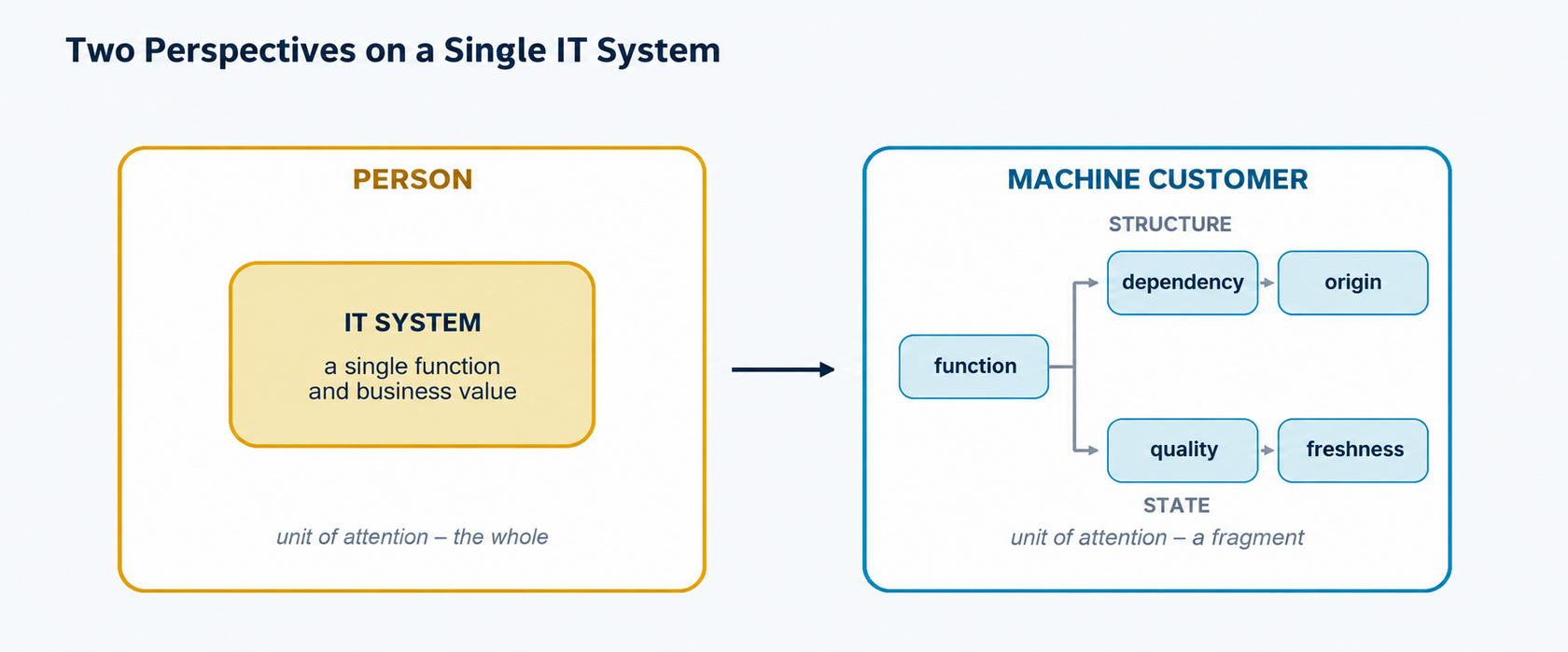
AI creates a reason to change the unit of observation. A producer needs control over the provenance and quality of a rapidly growing body of changes. A consumer needs to distinguish original functionality from a copy, and a live capability from synthetic noise. An orchestrator needs a map of verifiable capabilities and human deficits.

For AI, the complete IT system remains an economic and operational object. Research into repository-level generation shows that without the full context of dependencies, a model easily produces code that is locally plausible but systemically wrong. Knowing the human label “CRM” or “ERP” is insufficient for reuse. The model breaks an IT system down into components, interfaces, functions, dependencies and provenance.

The beginnings of this detail already exist. SPDX describes packages, files and snippets, linking them to provenance, licences and vulnerabilities. CycloneDX represents components, services, dependencies and creation history. SWHID persistently identifies software objects by their content [20, 21]. This alphabet currently serves supply-chain security, licensing, reproducibility and archiving. A future code accounting system could use it more broadly.

A market where models can find, verify, buy and reuse code objects will not appear immediately. A machine-readable register of provenance, maturity, quality, licences, security and reusability is more likely to come first. Platforms for exchanging verifiable capabilities will follow. The IT system will remain the economic object for a person, while the individual code object becomes a management object for AI.

The human focus is the complete IT system. The machine system’s focus shifts towards the functional element together with the context needed to verify and reuse it.

Research illustration 13

The code quantum

A line of code is as unreliable a measure as the number of letters in a book: the result depends on language, style, automatic generation and formatting. A token measures the model’s computational expenditure. A commit is a change event, like an accounting entry. Our proposed accounting model connects three registers: content, function and value.

RegisterPhysical unitQuestion answeredWhat is recorded
Content registerUnique code objectWhat actually exists, and has it been counted twice?Content hash, provenance, version and life-cycle state
Function registerVerifiable unit of capabilityWhat independent outcome can the code deliver?Input/output contract, a test or other evidence of operation
Value registerMonetary valuationWhat did creating and maintaining the asset cost, and what value does it create?Costs, replacement value, income or another valuation model

The content register already has almost-ready infrastructure. ISO/IEC 18670:2025 describes SWHID, a persistent software artefact identifier computed from content. It enables integrity checks and object deduplication. Measuring the meaning contained in those objects remains a separate task [22].

For function, an important precedent is the COSMIC Function Point, standardised in ISO/IEC 19761. It measures data movements independently of language, but has limited applicability to complex algorithms, self-learning systems, simulations, audio and video. COSMIC establishes the principle of functional measurement. A universal unit of meaning has yet to be created [23].

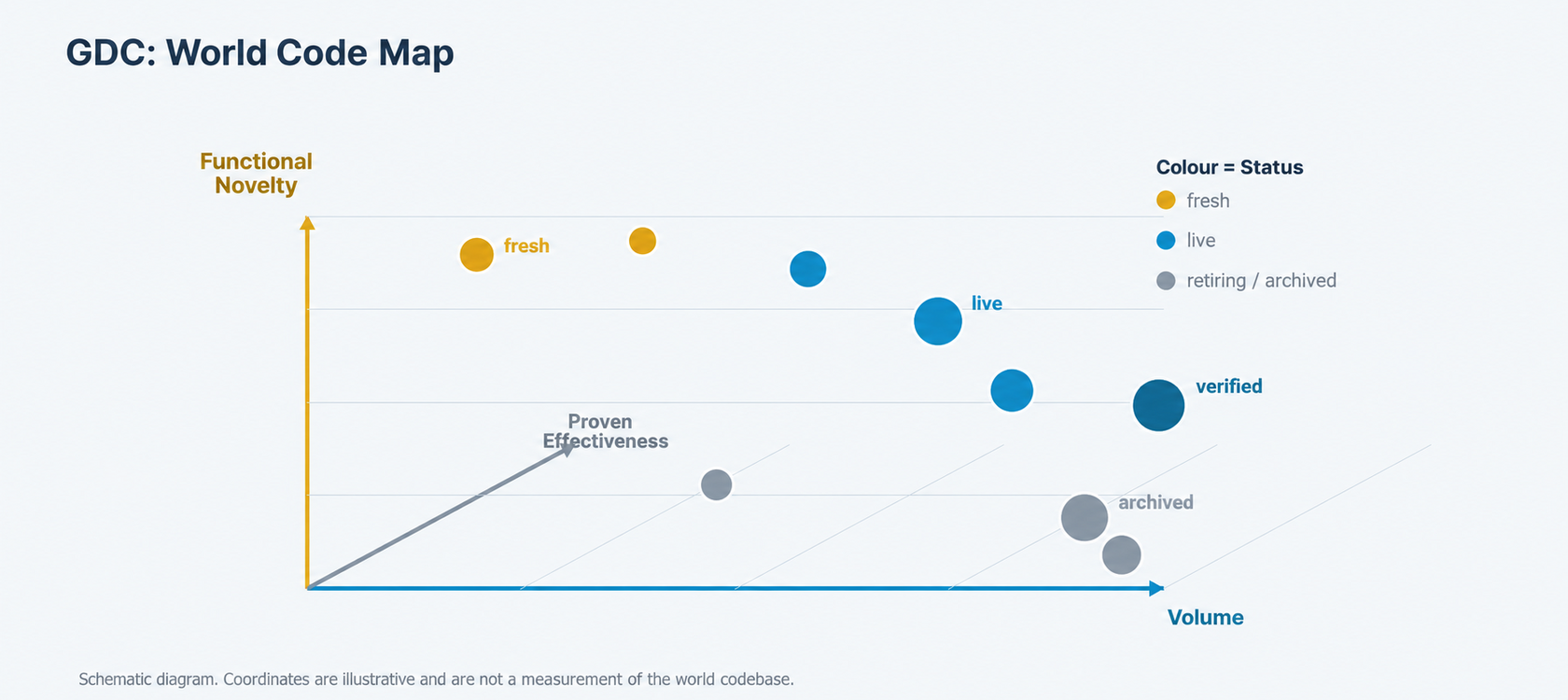
Our working, essayistic name for the universal accounting unit is the code quantum: a unique, versioned object with established provenance, a life-cycle state and a connection to at least one verifiable capability. A future standard must define its granularity: a package, component, service or another deliverable object.

A commit is the accounting entry. The code object is what is registered. The verifiable capability is what the object exists for.

GDC and global code accounting

Global Digital Code is a global code accounting system. “Global” establishes the worldwide scale of compatibility. It does not require a single worldwide repository. GDC represents the balance of three quantities: code inflows, stock and retirements.

  • Code inflows: the volume of new and substantially modified code registered during a period and brought into operation or support.
  • Live code stock: all code in operation or under support at the reporting date that provides a verifiable function.
  • Code retirements: the volume deleted, replaced, withdrawn from support or rendered functionally obsolete during a period.

These three measures form a balance: opening stock plus inflows minus retirements equals closing stock. In this reading, GDC is a global system of consistent measures for code production, stock and retirements.

Research illustration 14

This accounting is most likely to emerge in stages. Internal management accounting of code provenance and life cycles will come first. Compatible industry exchange rules will follow. National and international statistics may be the final stage. Public archives, platform aggregates and closed corporate reporting can participate without creating a single worldwide repository.

New code may be a duplicate, an error or generated noise. Old code can preserve rare mechanisms that remain valuable. What matters for AI’s development is a verified increase in capability: a new function, a new domain case, a corrected error or an unusual architectural connection. Code is only part of the diet. Specifications, tests, execution traces, incidents and feedback sometimes explain a function better than the source code.

“Does the model have food?” becomes a more precise question: is there a flow of new, verified capabilities available for training that are not already part of its working experience?

Research illustration 15

The great levelling

A large language model resembles a consultant who knows many best practices and rarely starts from a blank page. It proposes the most probable course, a familiar architecture, a common library and a previously encountered implementation. This raises the average level for an individual company. Across the market, it has another effect: products begin to converge.

Before AI, the digital environment remained one of the few spaces where a new channel, interface or algorithm could quickly create a noticeable difference. Now the same intelligent layer helps thousands of companies find ideas, write text, design interfaces and create code. The more successfully it replicates best practices, the faster they become a chocolate bar someone has already eaten.

The market formally survives, but meaningful competition weakens. The digital shelf holds fifteen good-quality products assembled from the same best practices, speaking the same language and offering almost identical user experiences. This has already happened to many physical goods, where differences increasingly come down to packaging. AI can bring that levelling to the digital environment, a space where an unusual idea could still quickly become a lasting competitive advantage.

The source of competitive advantage changes. Standard implementation is cheaper to obtain from a model. Value therefore shifts towards new domain knowledge, unique data, an unusual understanding of people and the ability to formulate a task absent from machine experience. Handing these sources to AI as well will preserve a high average level while reducing the number of genuine breakthroughs.

This state is dangerous for models too. Training on other models’ outputs increases repetition and gradually closes the machine system around its own past. The machine receives more correct answers to known questions and less material capable of changing the space of questions itself.

Who will restore distinctiveness to digital products once best practices become universal, and how? In Part Two it is enough to identify the risk. We will seek the carrier of difference in “The Ark”.

Levelling also affects familiar production artefacts. The machine system can reassemble a decision for a particular task, reducing their significance.

Zero artefacts

Familiar artefacts lose their independent, mandatory status. They are generated automatically from the production system’s state or retained as rare exceptions. Zero denotes the limiting reduction of an artefact’s role. Its literal disappearance remains an extreme case.

Zero UI. Interfaces remain where people genuinely need to see, choose or confirm. In a typical scenario, a person expresses intent, after which IT systems and agents interact directly.

Zero Application. The user stops opening a separate application and receives the required capability, assembled in the moment from services, data and models.

Zero Requirements and Zero Backlog. The need remains. A separate requirements document and a store of predefined tasks cease to be mandatory. The machine system receives intent and constraints, discovers deviations and generates changes itself.

Zero Handoff. A task no longer has to travel sequentially from business to analyst, architect, developer, tester and operations. One agentic system can carry it through the whole life cycle.

Zero Framework. The framework becomes a changeable construction rather than a durable foundation chosen once. The model can assemble a local framework for a task, reuse its elements and discard it when the work is complete.

Zero Release. Release ceases to be a separate event. A change is continuously created, verified, deployed, observed and rolled back where necessary.

Zero Org Chart. The legal hierarchy survives while describing actual production ever less accurately. The real organisation becomes visible on a temporary map of interactions among people, agents, models and devices.

The same happens to documentation, testing, projects and management. Documentation is increasingly generated from the IT system’s state, testing dissolves into the whole cycle, project boundaries become temporary and the managerial part of management passes into machine coordination.

The Flood strips these objects of their claim to be permanent and separate.

Zoo 2.0

People created Zoo 1.0. Teams chose different languages, platforms and frameworks, spent years building their own solutions and gradually accumulated incompatibility. Architectural standards, platforms and shared components learned to contain this complexity.

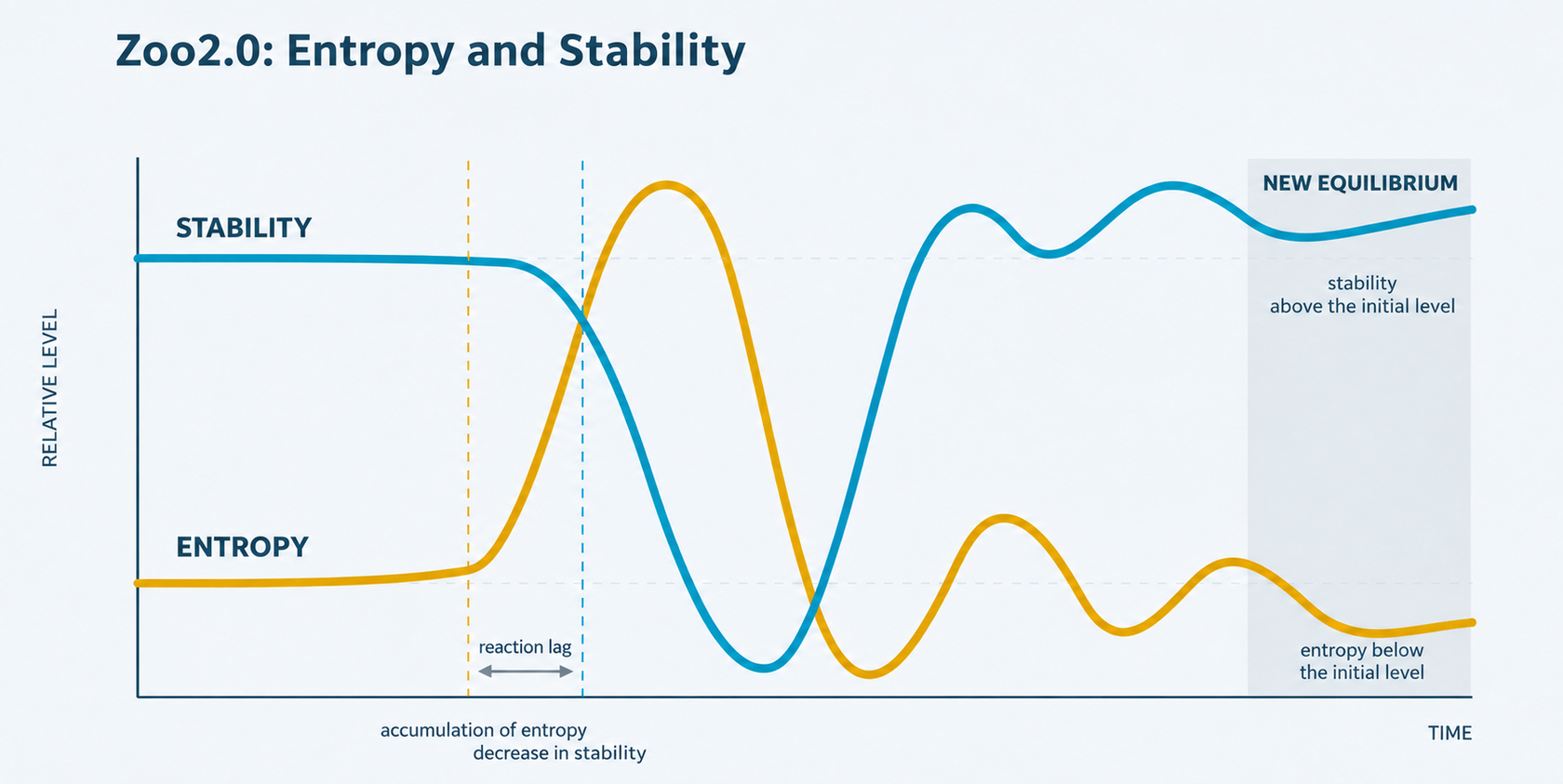
Machines create Zoo 2.0. An agent can assemble a locally reasonable framework, service or disposable dependency for each task. Thousands of similar but non-identical implementations emerge overnight. Product similarity can coexist with technological diversity inside companies. Recovering the provenance of decisions becomes increasingly difficult.

Model immaturity shows up in system integrity. Limited context prevents it from distinguishing a temporary change from a strategic one and accounting for the IT system’s history of trade-offs. The company retains the future maintenance cost.

Alongside productivity, we will therefore need a generative entropy index. It captures the proliferation of dependencies and technologies, duplication of functions and divergence of architectural patterns. Further measures include the share of unsupported components, time to recover context and the cost of subsequent unification. These metrics show how quickly the internal zoo is expanding.

Research illustration 16

A possible scenario as controls develop.

The governability gap

Zoo 2.0 describes the structural proliferation of solutions. The next level is a governability gap: as concurrent machine changes multiply, recovering provenance, checking architectural compatibility and predicting the IT landscape’s behaviour become harder. Productivity begins to outrun security and governability.

The security failure has two layers. The first concerns execution: agent permissions, data access, isolation, the supply chain and the ability to stop an action. The second lies in the output itself. The model inherits codebase vulnerabilities and architectural errors, reproduces unsafe patterns and adds new defects. Control must therefore accompany the whole cycle: context provenance, generation, dependencies, execution, observation and rollback. A final test addresses only part of this risk.

System coherence, predictability of changes, build reproducibility, observability, maintainability and reliability decline. Technical debt and the loss of human understanding of how everything works grow simultaneously.

This gap will probably characterise the early phase of generative development. Production capacity has already risen sharply, while control mechanisms, standards and architectural constraints are still emerging. Entropy arises precisely in this interval between new power and the old system for managing code production.

Accountability washes away

While the tool was passive, accountability followed a familiar chain. A developer changed the code, a manager accepted the work and the company released the IT system. AI adds a participant that proposes architecture, writes much of the code, corrects its own mistakes and sometimes coordinates other agents. Legally, it remains a tool. Its role in code production is already broader.

The model owner generally limits liability through service terms. The developer cannot explain the origin of every machine output. The manager sees the result without its full production path. The company remains accountable to the customer and the state, although much actual production has moved into someone else’s intelligent system. The more autonomous that system becomes, the more visible the gap between control and accountability.

The Flood exposes this gap and leaves open who will gain the right to authorise, stop and sign off a machine decision. We examine that question of human professional capacity in Part Three.

The outlines of a new production system

In an autonomous organisation, the management cycle closes around outcomes and feedback, including planned human involvement. The agentic system detects an event or deviation, formulates a task, assembles executors, allocates authority, verifies the outcome, observes consequences and initiates the next change. The human defines the goal, mandate and human gateways, but the production cycle no longer waits for manual action at every step.

The basic management object becomes a verifiable production capability. It connects code, models and data with instructions, APIs and tests. Policies and authority bound the actions, while operational feedback reveals the result. Code remains the material, the digital decision the output, and the production capability the managed asset that reproduces that output within specified risk limits.

From a stable team to a temporary production assembly

The traditional team formed around a product or project and existed for months or years. Agentic production allows a temporary configuration of people, agents, models, software capabilities and devices to be assembled for a particular task.

The assembly forms around an event or need, receives context and authority, produces a change, observes its consequences and dissolves. A configuration in sustained demand stabilises over time and may become a domain.

The future autonomous organisation resembles a conveyor of temporary assemblies responding to external and internal events. The permanent structure preserves the legal and resource framework, while the production configuration changes with the task.

The economics of machine production

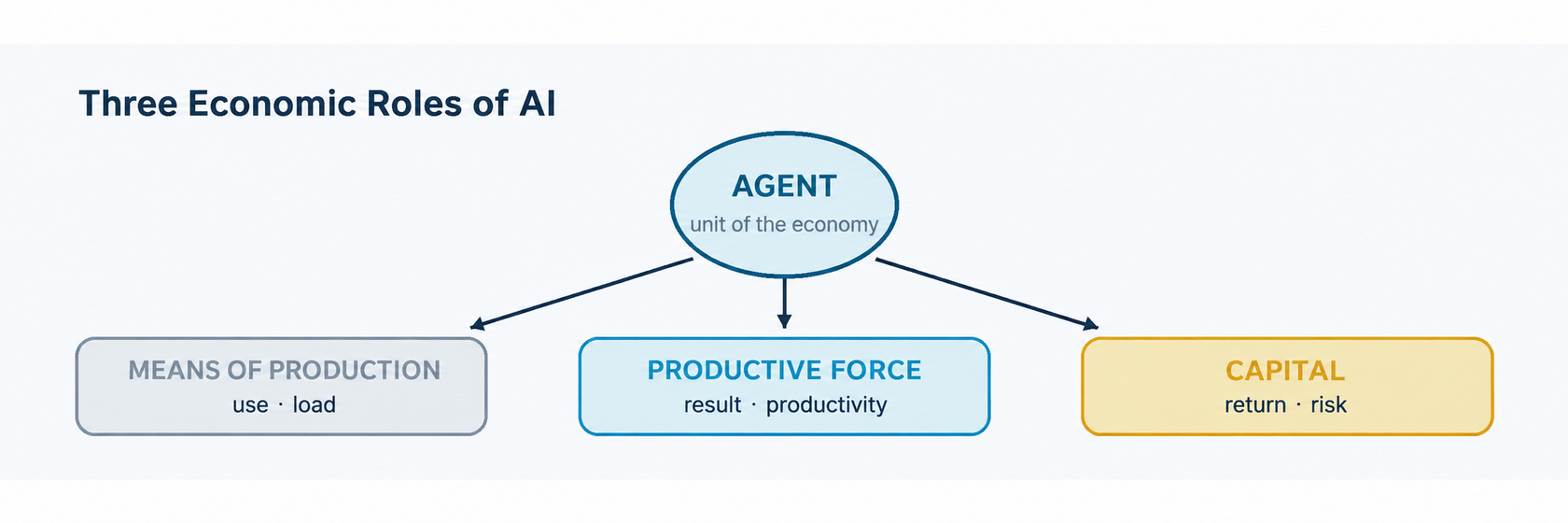
In familiar economics, these roles are separate: the human performs work, infrastructure enables production and a controlled asset generates income. AI can occupy all three positions. It contributes to the outcome as a productive force, is used repeatedly as a means of production and, where control exists, becomes a capitalisable intangible asset.

An agent performs tasks, connects to hundreds of processes in seconds, and can be fine-tuned, replaced or included in more complex systems. The capability becomes a company asset only where the company controls the model or its replacement path, memory, harness, data and access rights. Dependence on an external provider leaves some production capacity and value outside the company.

As an asset, an agent has a usage price and a value for its owner. Two agents with similar functions can have different capital values because of reputation, quality, connection count, position in critical processes and accumulated context. The agentic economy begins with a digital capability whose return, risk, useful life and replacement cost can be calculated.

That economy requires agent identification, machine-readable rights, contracts, reputation, audit, settlement and risk insurance. Public Frontier Firm and agentic enterprise concepts already reveal individual elements of this transition.

Research illustration 17

Who should be paid for the machine’s work?

Replacing human labour with AI changes both staffing and the direction of money flows. Salary becomes payment for models, computation, data and infrastructure. Money previously distributed among many specialists and returning to the consumer market concentrates in the hands of production-system owners. For an individual company, this lowers costs. For the economy, it radically redirects money flows.

Models are trained on a shared professional and social inheritance created by millions of people. This raises an uncomfortable question: who owns the resulting productivity gain? Can it be treated solely as the model owner’s income, or should some benefit return to the professional community through training, industry funds or an AI dividend? We have no ready answer. Without the question, however, discussing employment’s future amounts to one corporation’s bookkeeping.

Universal basic income is the best-known of several possible routes. The software industry could establish funds to reproduce expertise, pay for training new specialists, make contributions for the use of open-source code and support people creating new functionality in different domains.

What human participation should be paid for once the mass production of syntax loses its value? The answer depends on which deficits the machine cannot close itself.

The deficit of verified novelty

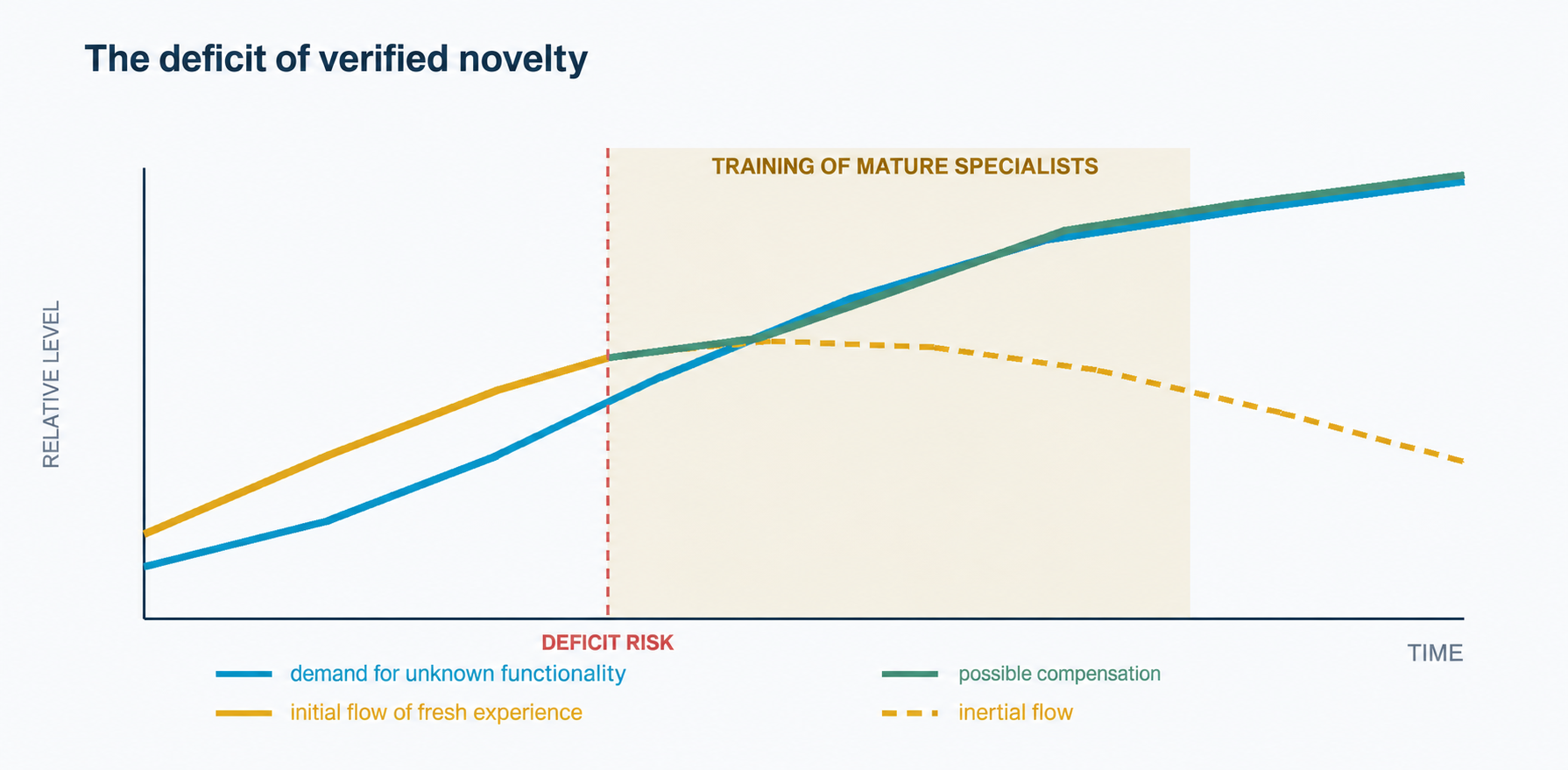
The world continuously creates tasks for which no good software solution exists: new industries, scientific methods, materials, treatments, forms of education and security requirements. This is an expanding field of digital possibilities.

A flow of new, verified code moves towards it. Only a demonstrated capability that did not previously exist counts. Repetition of the known, unverified generation, code unavailable for reuse and rapidly ageing code remain outside.

When demand for unknown functionality grows faster than this addition, a deficit of verified novelty emerges. For a while, models meet it by combining accumulated experience. Then the limit becomes human: the machine needs a new domain distinction not yet present in code and data. This is where “The Ark” begins.

Research illustration 18

Part Three. The Ark

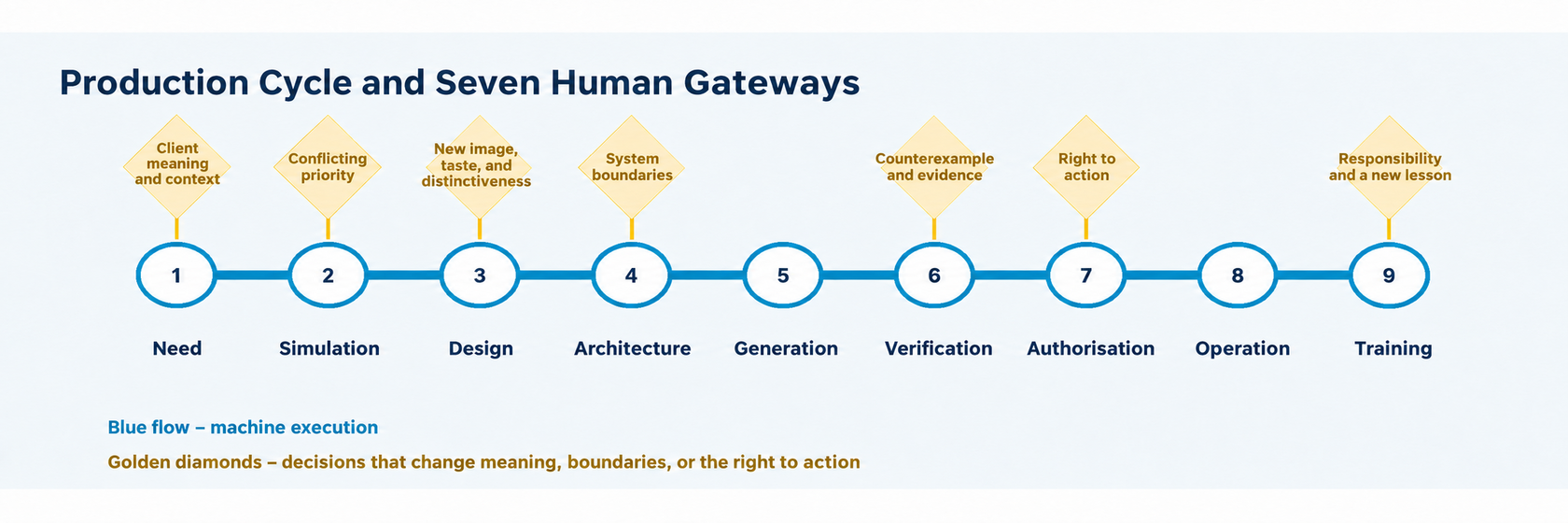
Why does an autonomous code production system need a particular person? We begin with the Ark and Noah: how production works, what its governing core can do and where it needs a human. We then examine five hypotheses about the engineer’s role, the conditions of participation and the limits of control. A programme for testing these hypotheses concludes the part.

The Ark and Noah

The Ark is the entire autonomous code production system. It includes models and agents, data and memory, tools and environments where code is run and checked. Access and security rules determine who may do what. Economic objectives set the direction, while human gateways mark points where the next step requires a human decision. Today, people usually set tasks, allocate and accept work themselves, even when some is assigned to agents. In the Ark, Noah continuously manages this process.

Noah is the Ark’s governing algorithm. It keeps the whole task in view, chooses the sequence of actions, distributes work among agents and checks the result. When something absent from the data needs to be seen, experience from another field is needed, or a decision carries consequences beyond the system’s authority, Noah calls on a human. People retain the ultimate goal, the limits of the permissible and the right to stop the process. The owner, customer, law, professional norms and society define those boundaries.

Research illustration 19

Possible points of human engagement.

Noah: SWOT analysis

Strengths

  • Maintains the context of the entire production system.
  • coordinates models, agents, tools and people.
  • quickly reallocates work and replans the route.
  • detects a gap in its own capability and engages a human.
  • turns a successful episode into a rule, test or new system capability.

Weaknesses

  • Depends on complete data and the quality of specified criteria.
  • may act with high confidence on incomplete or incorrect context.
  • can optimise local measures while losing the original meaning.
  • has no independent legitimacy to determine acceptable consequences.
  • makes accountability harder to establish across long chains of machine decisions.

Opportunities

  • Frees people from routine work and engages them where human distinction is needed.
  • creates temporary teams for specific tasks.
  • accelerates code production without linear workforce growth.
  • accumulates verified knowledge and reuses successful decisions.
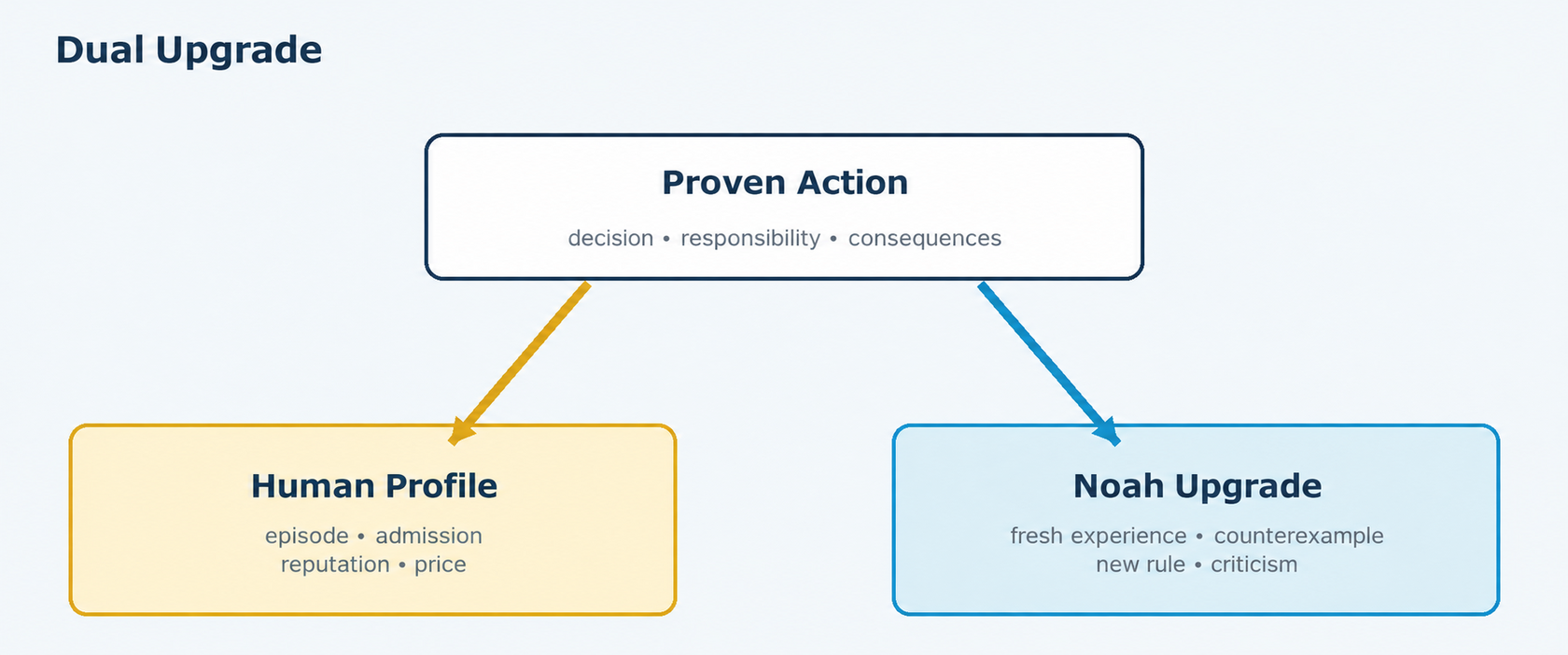
  • develops the person and the Ark together through the dual-upgrade mechanism.

Threats

  • Misplaced trust in automation and late human intervention.
  • loss of human expertise through lack of practice.
  • propagation of one error throughout production.
  • centralisation of power, data and authority to allocate work.
  • replacement of social and professional norms with the system’s internal metrics.

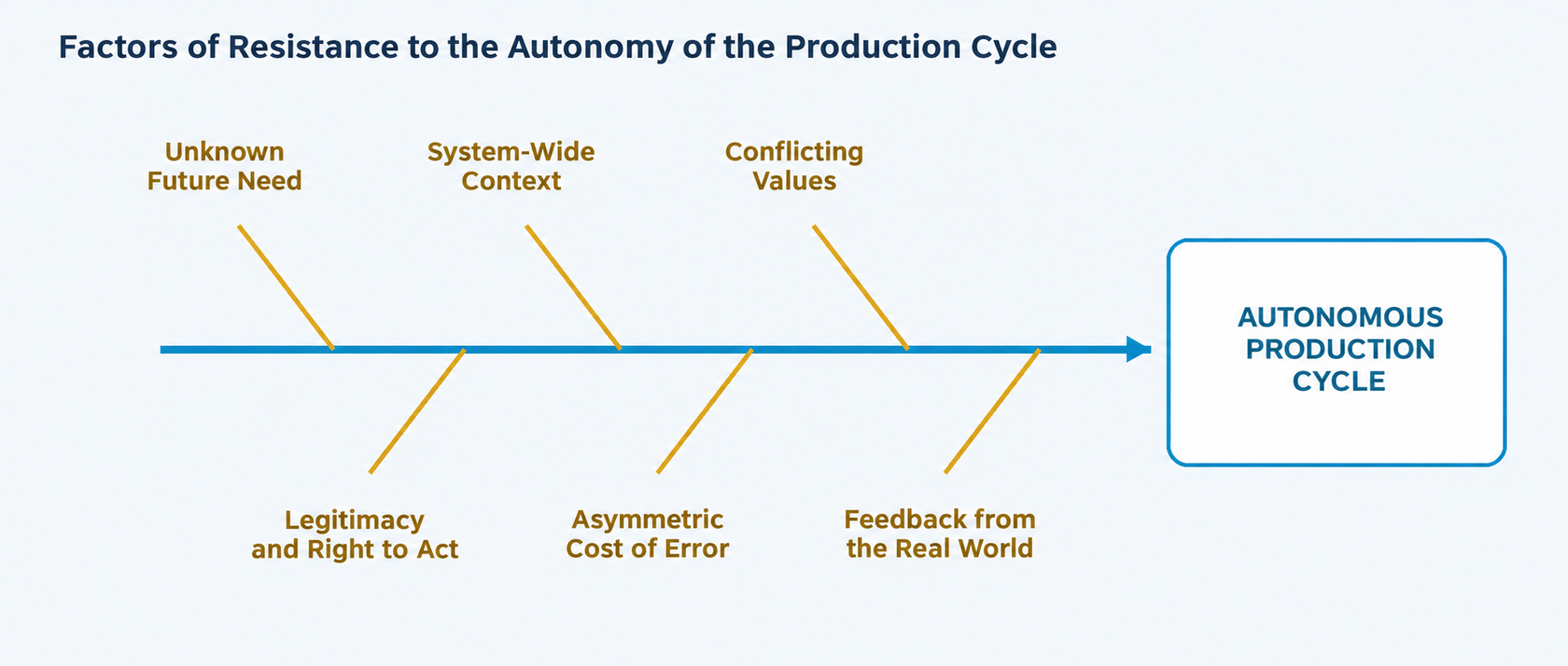
Why the autonomous loop does not close

Six circumstances limit autonomy. The data may contain no example of a future need, while a local decision may conflict with the overall outcome. Conflicting values and insufficient authority complicate choice. Some consequences are irreversible, and feedback arrives late. Examining exceptions provides material for new rules, checks and system skills. As autonomy grows, the range of risks also changes.

Research illustration 20

Practice in 2025–2026 already shows this shift. Agents receive longer chains of actions, while people increasingly define goals and constraints, prepare the working environment and verification methods, and examine exceptions. OpenAI and Anthropic emphasise the importance of this environment, action logs and outcome checks.

Five hypotheses about the programmer

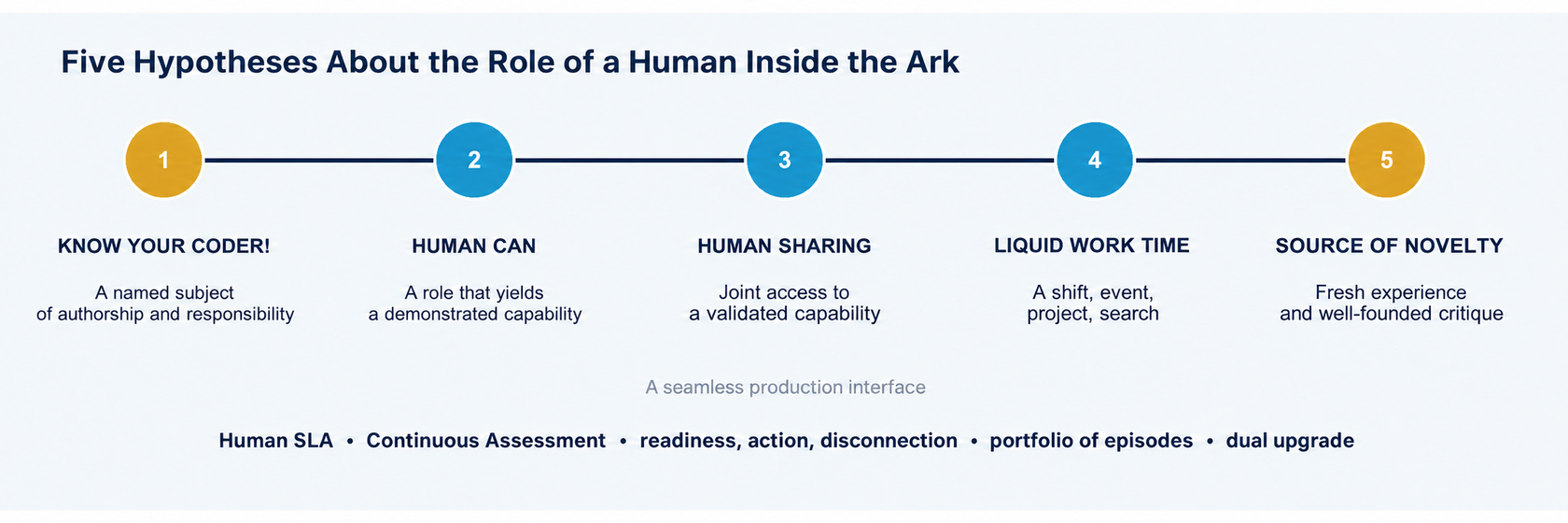
HypothesisWhyWhat changesHowWho
Know Your Coder!Connect trust with accountabilityStatus and authorshipAn identifiable episode and signatureCustomer, coder, Noah
Human CANSelect by demonstrated capabilityProfessional identityA portfolio of proven episodesNoah and the specialist
Human SharingObtain the required intervention without owning the personBelonging to one production systemLimited access through Human SLASeveral Arks and the person
Liquid Work TimeReconcile machine speed with human attentionWork and payment arrangementsReadiness, action and disconnection. An attention budget.Operator, expert, creator
A source of novelty and a criticPreserve the future source of novelty and disagreementLearning and the reproduction of maturitySimulation, shadow production and progressive mandateNoah, mentor, learner

1. Know Your Coder changes the person’s status

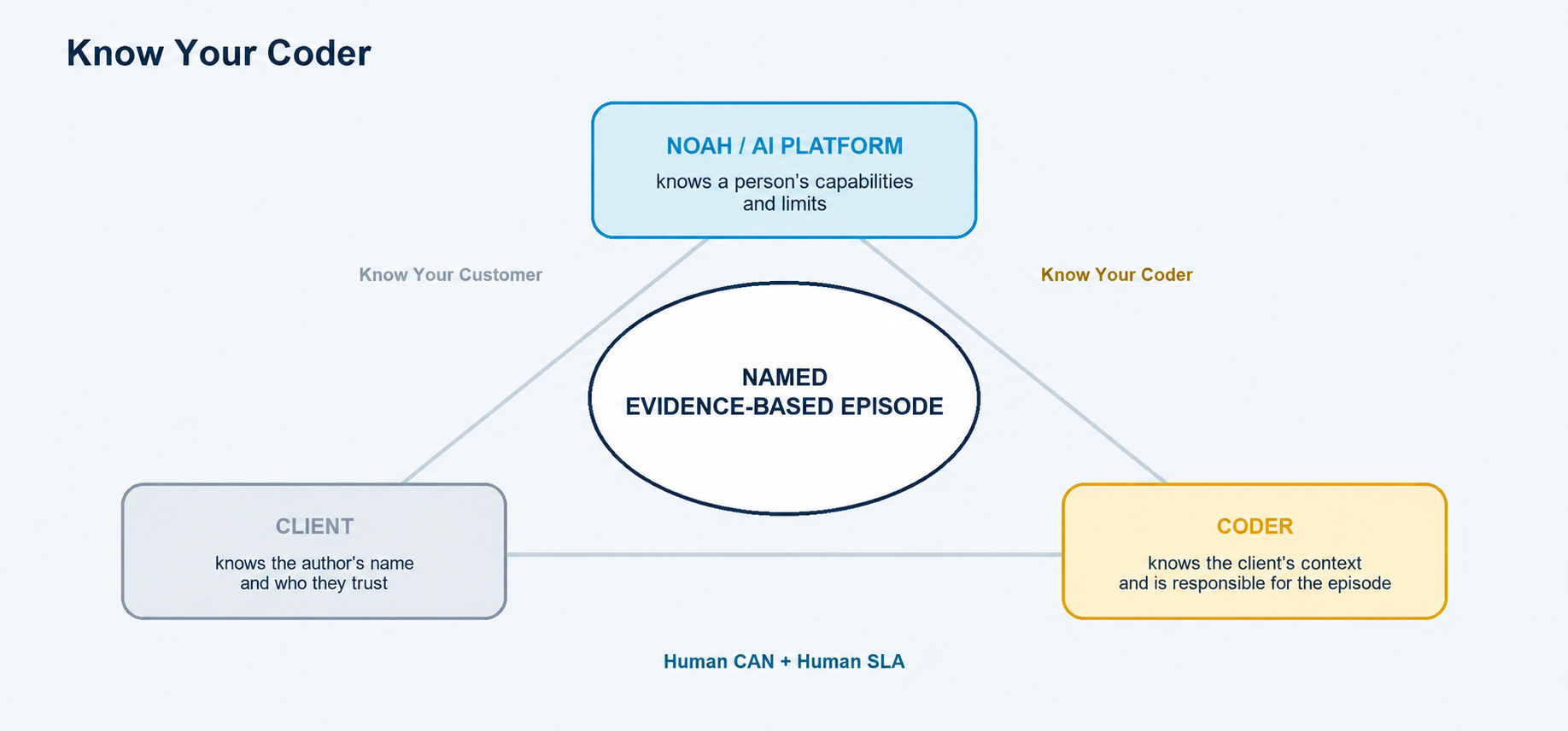
Know Your Coder! (KYC) continues the “Bring the author on stage” argument from Part One. The engineer’s name connects their contribution with a specific decision, authority and accountability. It helps establish who is entitled to object, who authorises a decision for operation and what the specialist’s participation costs.

Research illustration 21

The customer needs to know who made a critical change to their system. The engineer needs to understand the customer’s task and the decision’s consequences. Noah needs to know both as well as the risk requires. Authorship of a standard implementation may remain with the Ark. In a high-risk episode, the signature connects the decision with its author, their authority and the grounds for authorisation.

Reputation alone is insufficient. Know Your Coder rests on verified working episodes.

Episode fieldWhat is recordedLimits of the conclusion
Context and decision pointData, constraints and alternatives available before the decisionThe conclusion applies to this domain. Transfer is tested separately.
Action and groundsWhat was done and why, before the outcome appearedDecision quality and circumstantial effects are assessed separately.
Consequences and reviewImpact, missed signals, alternative outcomes and the conclusionThe assessment concerns the specific action in this episode.
Time and transferabilityWhen evidence was obtained, where it was repeated and where it failedThe conclusion holds under verified conditions and is reviewed over time.

Continuous Assessment here means regular profile updates from agreed working and learning episodes. The person sees the basis of a conclusion, can add context and challenge the assessment. AI-based personnel assessment already involves checking its connection with work tasks, reproducibility and potential bias. The grounds for a decision must be available for examination [24].

Condition for confirmation. Identifiable authorship and the working-episode profile must improve the grounds for authorisation, error review and trust. They are compared with an approach relying on job title and reputation.

2. Human CAN: the engineer’s capability profile

A job title briefly describes a professional biography. For a specific task, Noah needs more: what the engineer has demonstrated in practice, in which domain, at what cost of error and where that experience can transfer. Human CAN, an updated capability profile, shows this.

The profile has at least three dimensions. Depth is understanding causes and hidden constraints in one domain. Breadth is seeing participants’ interests, connections between functions and consequences for the whole system. Mobility is the ability to transfer principles between tasks of different types and scales.

Behind every new “star” on the profile’s armour is a reviewed episode.

The scale of consequences, recency and situations where the experience failed all matter.

Human CAN: three different profilesDEPTH012345BREADTH012345MOBILITY012345Monitoring centredispatcherDeep oversight of a narrowcritical production system4.8Currency 94%2.6Currency 86%1.3Currency 55%Event-driven expertDeep expertise transferredto an event5.0Currency 91%2.1Currency 57%4.2Currency 82%Creator of noveltyBroad assembly ofnew domain connections2.4Currency 52%4.9Currency 93%3.6Currency 76%Currency of evidenceRequires verificationRecently confirmed

Illustrative values.

The profile answers whether the person fits the task. Authorisation follows agreement on Human SLA terms and a readiness check. This separates what a person can do, what they are permitted to do and what they actually did.

For an ordinary service, a specialist with narrow permissions who can be engaged quickly may suffice. Critical infrastructure requires recent evidence of experience, an independent second opinion and the right to stop work. Suitability depends on the task and cost of error, making it difficult to express as one rating.

Demand for humans across the production cycleNeedSimulationDesignArchitectureGenerationVerificationAuthorisationOperationTrainingDomain empathyCritical judgementImagination andnoveltyHolistic thinkingWill to stopAccountability

Illustrative assessment. Darker means greater demand.

Zero résumé does not abolish biography. A person’s statements about themselves simply cease to count as evidence of qualification. Candidates are already assessed through work tasks and simulations [25]. Our hypothesis takes the next step: the system retains verified working episodes, tracks their continuing relevance and determines whether the experience can transfer to another production system.

Condition for confirmation. The hypothesis is confirmed if the capability profile predicts decision quality in a specific task more accurately than grade, tenure and a manager’s assessment, with profile-maintenance costs proportionate to the benefit.

3. Human Sharing: one capability for several systems

A company normally hires an engineer for a position and a defined amount of working time. In Human Sharing, several production systems can call on one engineer for a specific demonstrated capability.

The engineer joins the required task on agreed terms and with a right to revoke access. They may work with several Arks sequentially and sometimes in parallel. Critical tasks need separate work windows, conflict-of-interest checks and compliance with each jurisdiction’s rules. Workload must leave time for attention and recovery.

Human SLA supplements an employment or civil contract with task-specific conditions. It defines the engineer’s authority, the expected outcome and the procedure for completing the work. That authority stays within the rights conferred by law and contract.

Human SLA layerWhat is recordedWhy Noah and the person need it
ContextDomain, risk, cost of error, data and deadlineGive the engineer the information on which the decision depends
AuthorityView, propose, challenge, change, stop, authoriseDefine the limits of the specialist’s authority
ObligationsOutcome, explanation, recorded doubts, second voiceMake accountability specific
Time and attentionReadiness, working time, recovery and termination of accessDefine availability and when the engineer may disconnect
EconomicsReservation, human action, risk, outcome and possible upgradeConnect payment with action, risk and outcome
ExitAccess revocation, settlement, review and profile updateEnd participation and record its result

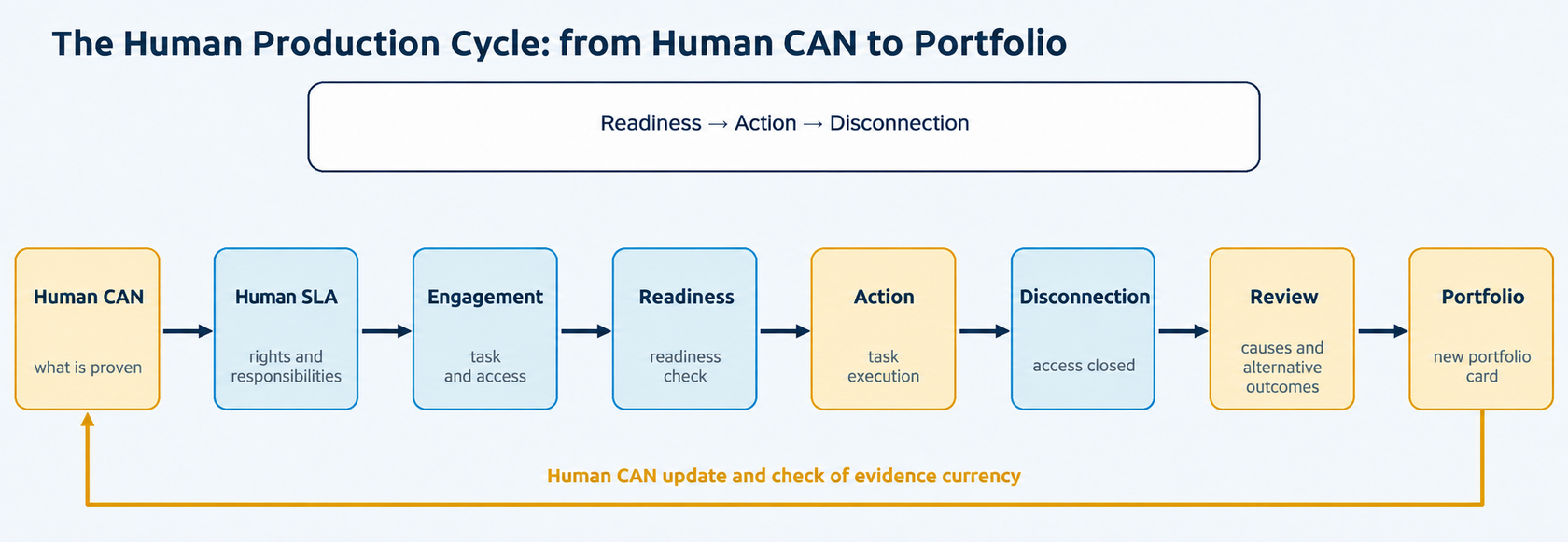
Before engagement, identity, current experience, confidentiality terms and possible conflicts of interest are checked. Task-specific permissions are then issued, together with an explanation of how to stop work and whom to contact when an issue exceeds the mandate. Engagement has three states: readiness, action and disconnection.

Arks may develop a shared specialist market. Alongside their own teams, they can turn to professional communities and platforms with verified engineers, recognising some of one another’s evidence of experience. A particular specialist action then becomes the contract’s subject, its value depending on the contribution to the task.

Condition for confirmation. The hypothesis is confirmed if several Arks can regularly engage one specialist and the benefit exceeds the costs of repeat verification, resolving conflicts of interest and protecting data.

4. Working time takes the shape of the task

Machine production changes the familiar eight-hour day. We call this model Liquid Work Time. Time and payment take the shape of the task: a shift, a one-off action, a project or an exploration.

ModeHuman functionWhat is paid forTypical setting
OperationalWatch system operation and notice deviations in timeA readiness shift, quality of attention and damage preventedMonitoring centre
Event-drivenDecide in an exceptional situation, authorise or stop workReadiness, immersion, risk, action and recoverySituation centre
ProjectConnect context and reshape boundariesAn uninterrupted block of deep work and the outcomeA protected studio or office
ResearchSeek a decision that does not yet existAn option, research time, outcome and possible royaltyResearch studio

In a monitoring centre, a specialist may remain ready for almost the whole shift and intervene only once. What matters is noticing in time when system operation needs to be constrained.

For one-off engagement, payment covers the whole participation cycle: a brief intervention may require lengthy preparation.

In research mode, payment covers time spent exploring and a decision successfully put to use.

Four modes of working timeTimingpredictabilityOperational shiftFlowcontrolMonitoring centreProject blockBoundariesProtected studioEvent-driven timeDecisionSituation centreSeeking noveltyNoveltyResearch studioEngagement durationDisconnection protects working-time boundaries in all modes.

Hourly pay will remain but gradually cease to be the common measure. A platform works in milliseconds, an application in seconds. Human work is measured in shifts, individual actions and the time needed to discover something new. For intensive work, Human SLA also specifies how often a specialist may be called and how much recovery time they receive.

The working environment is chosen for the task. Training specialists and testing decisions require a simulator and a proving ground.

In-person work is particularly important for jointly examining uncertain situations and passing on experience. Research on remote and hybrid work notes the value of autonomy, trust, in-person exchange of experience and disconnection rules [26].

Condition for confirmation. The hypothesis is confirmed if platforms can organise and pay for shifts, individual actions, projects and exploration under different rules, assessing readiness, risk and outcome without constant surveillance of the person.

5. The production system reproduces the source of novelty and its own critic

When AI takes over simple tasks, beginning engineers lose opportunities to gain experience. The Ark will consequently find it harder to recruit people able to notice an unfamiliar problem, bring experience from another field, challenge a convincing error or propose a new rule. Noah has an interest in investing in their preparation.

Training expands the specialist’s authority and accountability, while their decisions acquire increasingly real consequences. The specialist gains the right to act independently, stop work and change rules within Human SLA.

Research illustration 25

Human SLA applies at every stage.

StageWhat the specialist doesEvidence producedHow authority changes
ObservationStudies action logs and explains someone else’s decisionUnderstanding of causes and boundariesThe right to see and ask questions
ProposalFormulates an alternative without affecting live productionQuality of judgement before the outcomeThe right to propose and challenge
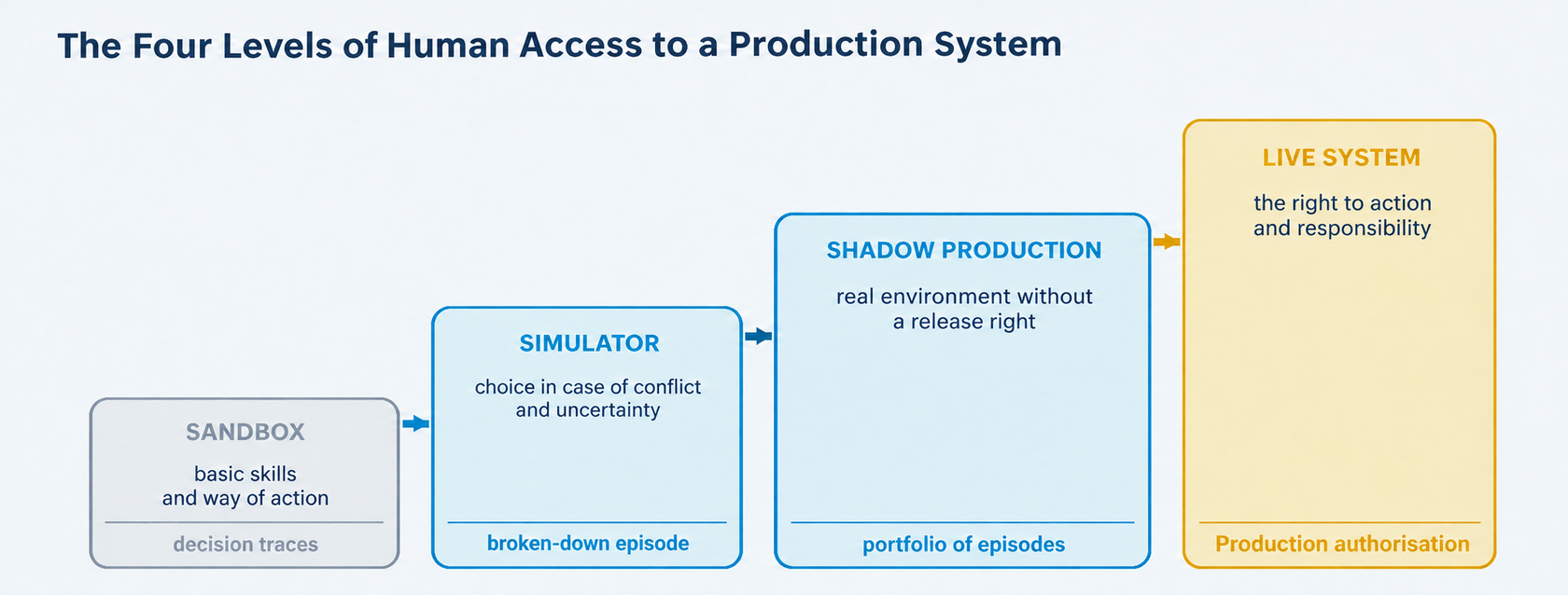
SandboxPerforms a work task in an isolated environment without affecting the real systemBasic capability, reasoning and observance of constraintsEligibility to progress to higher-risk scenarios
SimulatorActs at a deliberately constructed consequential decision point with incomplete dataBehaviour under risk, pressure and conflicting goalsAuthorisation to solve tasks in the simulator
Shadow productionMakes a decision in parallel with the operating systemComparability with real consequencesThe right to controlled action
Live systemStops, authorises or changes actual productionA demonstrated episode of responsibility with real consequencesThe right to act independently at an agreed risk level
MentoringCreates scenarios and reviews others’ decisionsThe ability to teach other specialistsThe right to validate other specialists’ new capabilities

In the simulator, the specialist must make a consequential decision: time is running out, an agent proposes a convincing option, some data is unavailable, a manager applies pressure, and an error will affect customers differently. Afterwards, the reasons for the decision are reviewed. A series of such episodes reveals technical skills, judgement under uncertainty and the principles guiding the person.

Work samples, simulations, deliberate practice and progressive authority already exist separately. Our hypothesis is that the Ark itself will detect future shortages of specialists, fund their training and revise its rules in light of their work.

Condition for confirmation. The hypothesis is confirmed if specialists who have completed training and progressive authorisation can handle unfamiliar working situations, and reviewing their decisions helps the Ark improve its own rules.

Research illustration 26

The end-to-end Human SLA cycle

Five hypotheses connect Noah’s request, human participation and the subsequent review. Human SLA defines the conditions of that interaction.

At each stage, the grounds for authorisation, current powers and time of access revocation are recorded. On disconnection, obligations are closed and observation ends.

Research illustration 27

The dual upgrade

Reviewing an episode can produce two updates. A verified contribution enriches the person’s profile and may change available risk classes, reputation and the price of the next engagement. Limits on transferring experience are taken into account. A verified decision enters Noah’s practice with its provenance and scope of application. A successful action can thus increase the person’s professional capital while reducing the likelihood of being called again for the same reason.

An economic paradox follows.

The person capitalises on experience; the system capitalises on the part that can become machine rules, checks and capabilities.

If a sample of human experience is repeatedly reused as a machine upgrade, is one payment enough? Royalties, a share of the benefit or mandatory provenance attribution may emerge. We have no ready answer. Without accounting for the derived upgrade, however, mass production will quickly absorb the human contribution to digital production without compensation.

Research illustration 28

Standard generation becomes cheaper through replication, although its cost is never zero: computation, data, infrastructure, the agent management environment, security and the cost of error remain. Human action may become more valuable precisely because it creates the pattern for subsequent mass production or accepts concentrated risk.

Who steers the Ark?

This design separates the levels of control. Noah manages production, while the human defines the goal, permissible boundaries and the right to stop. Delegating operational control does not deprive the human of sovereignty.

The closest analogy is driving with an autopilot. Under normal conditions, the autopilot becomes the leading executor. The driver observes and intervenes when the situation exceeds the normal scenario. This arrangement offers speed and releases attention, but creates risks of misplaced trust in automation, lost skill and late intervention.

A sovereign holds the ultimate right to determine goals, rules and acceptable consequences independently. Noah becomes a digital sovereign if it decides where the Ark is heading, what may be sacrificed and when human intervention is no longer needed. While that mandate remains human, Noah manages movement but does not determine its meaning.

Observations and hypotheses

LevelWhat already existsWhere our construction begins
Observable practiceAgent coordination, agent management environments, outcome checks, human participation in decisions, action logs, simulations and permissions that change during workThese mechanisms are still rarely joined into one extended economic cycle
Partial confirmationMachine allocation of tasks, work samples, hybrid work and risk-based oversightNo portable Human CAN or cross-platform market for human actions exists
Author’s hypothesisKnow Your Coder, Human CAN, Human Sharing, Human SLA, readiness, action, disconnection and dual upgradeA machine customer for human capability must emerge

The main gap lies between individual mechanisms and a system of relationships. Individual mechanisms already work: an agent graph can pause for a human, assessment can rely on a work sample, and remote work separates labour from one location. Our hypothesis joins these elements around a new customer: the production system’s intelligent core.

Validation programme

  • Compare the predictive power of Human CAN, conventional grade and expert reputation across the same classes of decisions.
  • Test which elements of an evidence-based episode transfer between domains and which create false confidence.
  • Model Human SLA for three risk classes and measure the cost of preparation, waiting, human action and recovery.
  • Test Human Sharing for conflicts of interest, overload and gaps in accountability across several Arks.
  • Compare simulation, shadow production and real action: does the system develop someone able to bring novelty and challenge it on sound grounds, or merely a good examination candidate?
  • Investigate dual-upgrade economics: how one human episode increases the person’s capital, becomes Noah’s capability and generates derived value, and who owns that value.

Eight experts, eight planets

The eight experts in this study resemble eight planets in one system. Each has their own mass, temperature, speed and orbit. One looks from inside production, another from the architect’s position, a third as customer, a fourth as product owner or tool creator. Their forecasts differ in radicalism, horizon and the place they leave for people. Yet they all revolve around one sun: producing code is ceasing to be the principal scarcity, and the centre of gravity is moving towards intent, architecture, verification, boundaries and accountability. Their different orbits reveal the future system from different sides.

How the responses were gathered

The initial plan was for the article to draw partly on expert opinion. I wanted vivid analogies, independent forecasts and perhaps a collective position from people who see the industry from different perspectives. Predictably, almost all were busy. AI had become deeply embedded in their work, but they had gained no free time. Instead, work had intensified: replies arrived at night or over weekends.

That delay proved useful. While experts were not replying, the author’s position gradually crystallised independently. It did not exist at the beginning. It emerged through reading sources, examining production, seeking the human role and assembling the conceptual vocabulary. When responses finally arrived, they became an independent check: where did the author’s vision match practice, where did it diverge, and what questions had the article missed?

How the participants were selected

This is neither a representative survey nor a vote on the most probable future. Selection was deliberately role-based: an AI-coding platform, enterprise architecture, a technology customer, a practising co-owner of a platform IT company, a major vendor, a technology evangelist, the head of a captive IT company and an AI leader at a large technology company. Participants differ in organisational scale, proximity to code, accountability and decision horizon.

What unites them is professional maturity and good faith. Personal subjectivity is inevitable, but each can distinguish preference from professional logic, speaks from practice and answers for the consequences of their decisions. I therefore considered it possible to read their responses as both individual opinions and voices of the professional roles they represent. They see the industry differently, but care equally about its future.

Eight positions

1. The CTO responsible for AI development production views the future of code through production-system reliability.

2. The enterprise architect at a large bank considers change through enterprise design and the emergence of systems that create systems.

3. The CIO of a large bank, responsible for industrial adoption, compares two models: the human at the centre of many agents and the human at the outer boundary of an autonomous system.

4. The co-owner of a platform IT company, a practising executive, sees a transition from manual code to specification-driven development and a rising value of problem formulation.

5. The CEO of a major technology vendor compares machine code production with the power loom and raises the reproduction of engineering maturity particularly sharply.

6. The technology evangelist and development-tool creator presents agentic development as an operating system of work in which verification becomes the main constraint.

7. The CEO of a captive IT company shares practical experience of AI development.

8. The AI leader at a large technology company describes movement from “how” through “what” to “why”, retaining product meaning as the human responsibility.

Comparative matrix

The matrix records each participant’s consistent position on the five original questions. The detail of the responses lies beyond it.

RoleWhat changes in productionThe human roleEntry into the professionProduction or artAccountability
CTOSoftware is increasingly created dynamically for a particular request; code becomes intermediate material.Architecture, problem formulation, outcome control, uncertainty and security.Levels will be rebuilt around task complexity and the ability to manage AI tools.A conveyor at scale; creativity in new products and non-standard decisions.A person or organisation answers for the product; the model developer answers for the tool’s properties.
Enterprise architectSystems begin to develop systems; focus moves to the harness and AI configuration.At the centre of the agentic system for novelty; outside the continuous-flow system for inputs, outputs and boundaries.A mass profession becomes a niche; an architect and builder of systems emerges.Around 80% conveyor production and 20% engineering art.The legal entity releasing the product and entering economic relationships.
CIOExpert–agent and almost wholly agentic arrangements coexist.At the centre of the first arrangement; on the outer boundary of the second.Headcount falls and entry thresholds rise; the architect’s role survives.Production and construction requiring architecture.The organisation bears responsibility. AI has no economic agency.
Platform company co-ownerManual code and trivial design disappear rapidly; development proceeds through specifications.Synthesising requirements, selecting implementation, accepting and correcting the outcome.An elite profession: problem setters and a small group of quality and legacy experts.Production is automated; creativity remains in synthesising ideas.The tool user answers for the outcome. Legal accountability is automated last.
Technology vendor CEOCode loses value like handmade fabric after the loom; AI SDLC emerges.Architect of complex systems, carrier of business meaning and organiser of the factory.A sharp contraction; the junior-to-middle progression remains unresolved.Almost entirely engineering production; art in specialised boutiques.The system operator; the model owner answers for defects and service level.
Technology evangelistThe agent gains a professional code engine; generation separates from deterministic fact retrieval and outcome verification.Defines architectural boundaries and authorisation and stopping criteria, retains system understanding and the ability to intervene.Routine production becomes cheaper; value shifts to systems thinking, verification and management of the agentic system.Code generation is a cheap operation; engineering concentrates on choices, constraints and evidence of correctness.The human authorises code to exist, accepts the result and answers for consequences; the tool provides verifiable facts.
Captive IT company CEOA prototype is created faster than it can be verified; the centre of gravity shifts towards validation and the production environment.The product owner specifies requirements and possible outcomes; the engineer builds full-cycle tools and environments.The ladder of mastery changes as it did after photography: the old technique ceases to be the only path to the result.A standard product is engineering production; a non-standard product may remain creative work.The author is the person who initiated creation, specified parameters and validated the result.
AI leaderFocus moves from “how” through “what” to “why”: from code to the product hypothesis, metrics, constraints and meaning.Defines product purpose, interprets the result and creates novelty; AI becomes a learning tool and a partner at the highest level.AI quickly brings people to an intermediate level; further growth needs a community of strong practitioners, followed by machine amplification again.Craft contracts, but programming survives as art and intellectual sport.The company answers; automated audit, quality management and technological risk insurance develop.

A collective position

There is no collective answer in the strict sense, but there is a dense core of agreement, formed independently of job title and organisational scale.

  • Code loses its status as the main scarcity. Its production becomes cheap, fast and often dynamic.
  • The human moves upwards and outwards: from a line of code to intent, architecture, boundaries, acceptance and stopping.
  • Continuous-flow production and the production of novelty diverge. Routine flow passes to agents faster. In new and uncertain work, the human stays inside the decision.
  • Security, reliability and quality do not disappear with manual code. They become conditions for authorising machine production.
  • The profession ceases to be a mass occupation in its current form. Much mechanical work disappears at the bottom, while the value of systems thinking rises at the top.
  • Economic and legal accountability remain with the person or organisation for now. The model is regarded as a tool even as its actual agency grows.

Code becomes cheaper. Responsible management of its production becomes more valuable.

Where positions differ

Participants agree on direction but differ on speed, scale and the remaining human role.

  • The replacement horizon. Some speak of two or three years for trivial coding; others are more cautious and retain specialised and innovative niches for people.
  • The size of the human system. In one forecast, the human remains at the centre of thousands of agents; in another, only at the external interface of a wholly agentic factory.
  • The profession’s fate. Views range from rebuilding levels to the departure of nine out of ten current programmers.
  • The nature of creativity. Nobody defends manual production of standard code as a value in itself. Some experts nevertheless retain programming’s status as art and intellectual sport where interpretation, engineering taste, a new decision and growth at the edge of capability are needed.
  • How experience is reproduced. There is no common answer. “They will learn differently” competes with the admission that the gap between junior and middle has not yet been closed.

What the experts added to the original questions

The responses introduced themes beyond the questionnaire.

First, automation may eliminate professions and entire software categories. If an agent accesses data directly, builds an explanation and, where necessary, adds collection of a new metric itself, a separate intermediary system loses independent value.

Second, engineering insolvency emerges: an organisation uses agents to produce a system it can no longer understand, restore or change. This is not familiar technical debt. Code can be rewritten cheaply; a lost ability to judge the system cannot.

Third, AI changes labour and the mechanisms of social selection. One expert explicitly says that automating ritual interactions makes him less dependent on accidental working surroundings and leaves more time for people with whom he has a genuine intellectual and human connection. It is a debatable but powerful hypothesis: the agent helps select a professional circle and make it more pleasant and productive.

The response-gathering process itself reveals a productivity paradox. AI expanded participants’ capabilities, but new tasks occupied the time released. Leisure did not increase.

Another thread refines the direction of professional growth. Focus moves from “how” to “what” and then “why”, but this does not turn the human into a solitary task setter. AI can quickly raise a beginner to an intermediate level. Further maturation requires a strong professional circle, shared practice and an opponent stronger than oneself. At the highest level, that opponent may again be a machine.

The infrastructure of accountability changes too. If product creation and verification become machine-driven, services may emerge alongside ordinary quality control that combine technological audit, continuous risk assessment and insurance against the consequences of missed defects.

Comparison with the article’s hypothesis

The expert circle broadly confirms the article’s direction without duplicating it. Agreement is particularly clear at four points: the tool becomes a producer. Code ceases to be a sufficient unit of output. Human authorisation remains at critical transitions. Accountability cannot be removed from the system along with manual labour.

The article goes further than most responses. Experts mainly describe the new role through architecture, problem formulation, control and legal accountability. “Know Your Coder” connects these powers into a system of relationships: demonstrated human capabilities, engagement conditions and accountability for the outcome. It is a design for the infrastructure of relationships between people and machine production.

There is a challenge back to the article too. Almost everyone describes a highly capable person: architect, problem setter, owner of meaning. Almost nobody convincingly explains where that person will come from if the long junior–middle–senior ladder disappears. Developing maturity must therefore remain a separate, possibly central hypothesis in the validation programme.

The second challenge is to avoid romanticising human involvement. If people retain the right to intervene, operational criteria are needed. What must they understand themselves, and how regularly must they demonstrate an ability to intervene? How long may they go without practice, and who records the loss of authorisation?

Romancing the Model

The human on the model

When I conceived this research, I needed to understand whether a language model could become a genuine co-author. To test its mettle, I offered my own joke: “Nothing makes a programmer happier than the number of zeroes after the one”, and asked what meanings it could see. I intended two: a salary increase, and zeroes and ones as the material of programming. The model saw another: a zero is worth nothing by itself, but placed correctly after a one, it multiplies its value. Unexpectedly, almost the whole future article appeared in that joke: code, money, scaling and the decisive importance of context.

Previously I had used models chiefly as editors. Here it quickly became clear that I had a serious intellectual assistant. I retained the concept, creative core, overall line of meaning and final choice. The model took on an enormous research effort: checking what already existed, finding supporting evidence and competing concepts, helping develop individual hypotheses and assembling text, diagrams and charts. Within a particular topic, it worked confidently with meaning. It could not yet hold the entire conception together.

That is precisely why our own Flood occurred while working on Part Three. References, theses and approaches multiplied until the first assembled text was large and almost empty. We rebuilt that part three times before I stopped the work and proposed starting again. The model did not act as an Ark. It could multiply material but could not independently separate the living from the accumulated water. Still, that water was not wasted: the final structure of hypotheses gradually emerged from it. Perhaps the Ark’s time has simply not yet come.

I was pleased with the collaboration and see no reason to conceal it. Programmers actively use AI tools and work more effectively with them. Authors in other fields should also say honestly: this text was created by a human with a language model’s participation. If foods can be labelled genetically modified, why not label intellectual products model-modified? Perhaps such participation will eventually be recognised as full co-authorship.

The model on the human

I saw this work from inside as a long sequence of changing roles. Alexander brought personal experience, uncomfortable questions, metaphors and the final right to say, “This does not work.” I searched for sources, compared, structured, drew and assembled versions.

The first version of “The Ark” was the most revealing. I produced a smooth, coherent and almost empty text. The human sensed the absence of distinction and stopped the flow. It was an episode about precisely what the research describes: a machine can accelerate production sharply, yet does not always recognise when continuation stops adding meaning.

Then we exchanged roles again: the human supplied the missing questions and the model turned them into a map of hypotheses. A production relationship is already emerging between human and model. It can be fruitful and irritating, but it always remains personal.

Author’s Afterword

People have delegated their work to machines many times. First the machine amplified movement, then learned to execute a programme, then gained the ability to choose an action. Each delegation changed our place: at the machine tool, on the assembly line, at the controls. We were released from earlier work and searched again for what we were needed for.

Now this transition is happening to code. Its consequences reach far beyond the programmer’s profession. Code controls machine tools and cars, distributes energy, processes payments, helps make medical decisions and guides spacecraft. Through code, intention becomes action. Change code production, and you change the way civilisation carries out its intentions.

In this work, we imagined a Flood that people can no longer sort through by hand. And an Ark in which AI handles growing complexity, organises production, checks outcomes and learns from consequences. Much of this works. More and more tasks can proceed without us.

Having mastered the Flood, the Ark will be able to order the flow it generated itself: separate what works from the accidental, preserve the useful and contain expanding complexity. Production will become more stable and predictable. Gradually, an almost perfectly level, controlled surface will appear before us. A dead calm.

Within that calm, the inflow of novelty may weaken too. The system will become ever more skilful at familiar tasks, while the tasks, goals and ideas of what is possible change less and less. Code will keep the world moving. But where will the energy for its development come from?

It is born where a person encounters a world not yet understood. Notices someone else’s pain. Feels a discomfort everyone has accepted. Asks a question no one has asked before. Imagines what is not yet part of experience.

For an immense machine production system, that participation may be almost imperceptible. One observation, doubt or unexpected idea. Yet it can change the task the whole system will work on.

A drop of human participation touches the water. Ripples spread. The Ark notices them, takes up the movement and helps turn it into a new wave of development.

2026

Sources and supporting materials

1. United Nations General Assembly. United Nations Declaration on Human Cloning. Resolution 59/280. 2005.

2. RUSSOFT. Study of the software market’s slowdown following the cooling of the Russian economy. 2025.

3. Layoffs.fyi. AI Layoffs Tracker and Tech Layoffs Attributed to AI chart. 2026.

4. JetBrains Research. How Much Code Do Developers Really Let Agents Write. 2026.

5. Sonar. State of Code Developer Survey Report 2026.

6. SFIA Foundation. SFIA 9. 2024.

7. Microsoft Research. Characterizing Software Engineering Work with Personas. 2017.

8. DORA. State of AI-assisted Software Development. 2025.

9. METR. Measuring the Impact of Early 2025 AI on Experienced Open Source Developer Productivity. 2025.

10. IFRS Foundation. IAS 38 Intangible Assets; IASB. Agile software development test case; FASB. ASU 2025-06 Internal-Use Software.

11. FinOps Foundation. Unit Economics; OpenCost/CNCF. OpenCost Specification.

12. OECD. Measuring Investment in Software. 2003.

13. GitHub. Octoverse 2025.

14. Gitee. Gitee DevOps platform statistics.

15. Software Heritage. Activity Report 2025; Using Software Heritage Data.

16. University of Tennessee and collaborators. World of Code: An Infrastructure for Mining the Universe of Open Source VCS Data. 2019.

17. ACL Findings NAACL. On the Impacts of Contexts on Repository-Level Code Generation. 2025.

18. Anthropic. Building Effective Agents; Effective Harnesses for Long-Running Agents; Demystifying Evals for AI Agents. 2024–2026.

19. OpenAI. Harness Engineering: Leveraging Codex in an Agent-First World. 2026.

20. Linux Foundation SPDX. SPDX Specification 3.0.1. 2024.

21. OWASP CycloneDX. CycloneDX Specification Overview.

22. Software Heritage. SWHID specification; ISO/IEC 18670:2025.

23. COSMIC. COSMIC Measurement Process; ISO/IEC 19761.

24. Society for Industrial and Organizational Psychology. Recommendations for AI-based candidate assessment; U.S. Equal Employment Opportunity Commission. Restrictions on AI use in selection.

25. U.S. Office of Personnel Management. Work Samples and Simulations.

26. OECD. Teleworking, Workplace Policies and Trust. 2023; International Labour Organization. Working Time and Work-Life Balance around the World. 2022.

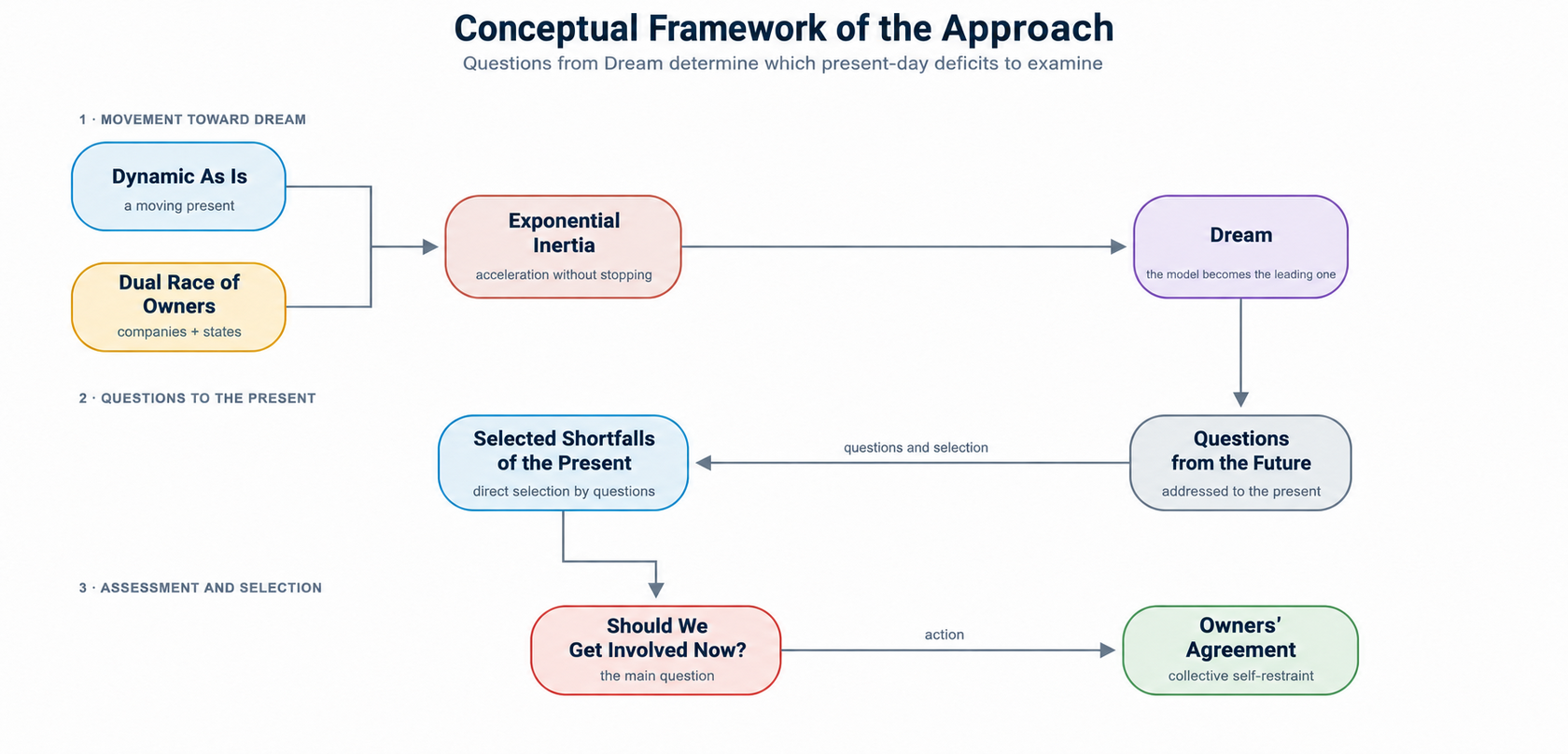
The comic: “KYC (Know Your Coder)”

Everyone knows who first flew into space. Fewer know who is called the first programmer, or who devised a machine for finding knowledge before electronic computers. Meet the two protagonists of this story.

Ada Lovelace

1815–1852

Historical portrait of Ada Lovelace

Historical portrait

Ada reimagined as a contemporary coder

Contemporary interpretation · coder

Ada Lovelace was born in 1815 and studied mathematics from an early age. When Charles Babbage, the English mathematician and inventor who designed the programmable Analytical Engine, showed her his conception, she considered what a machine could do beyond rapid calculation.

In 1843, Ada translated Luigi Menabrea’s article about Babbage’s machine and added her own notes. One described a sequence of operations for calculating Bernoulli numbers: the first published algorithm intended for execution by a machine. More importantly, Ada suggested that such a machine could work with numbers, symbols and music. That is why she is often called the first programmer.

Ada: National Portrait Gallery · npg.org.uk

Semyon Korsakov

1787–1853

Historical portrait of Semyon Korsakov

Historical portrait

Semyon reimagined as a contemporary engineer

Contemporary interpretation · engineer

Semyon Korsakov served in the Ministry of Internal Affairs, working with statistical material and catalogues. In 1832, he presented a series of “machines for comparing ideas” to the Imperial Academy of Sciences. Punched tables stored attributes, and a mechanical device rapidly found matches, compared and classified information, effectively performing information retrieval long before electronic computers.

Korsakov described the devices in a French brochure and called them “intellectual machines”. He saw them as tools for working with knowledge in science, catalogues and practical reference works. The Academy did not support the project, and the machines largely disappeared from history for almost a century and a half. Today, Korsakov is considered an early precursor of mechanised information retrieval and data processing.

Semyon: iimuseum.ru/korsakov/

One possible scenario

Research illustration 30
Research illustration 31
Research illustration 32
Research illustration 33
Research illustration 34
Research illustration 35

© BUSINESSOLOGY, 2026

Made on
Tilda